




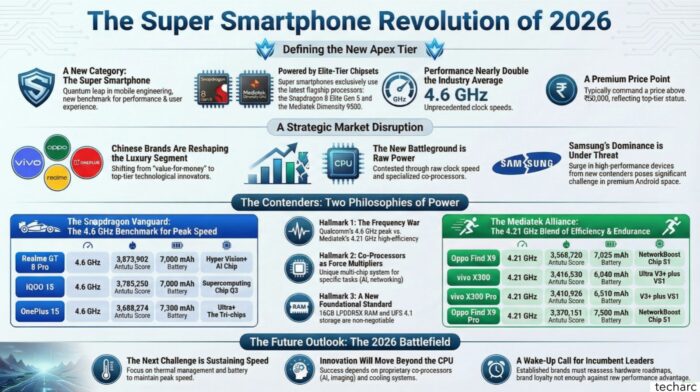
The mobile industry is currently witnessing a pivotal moment with the emergence of the super smartphone. This new category of device represents a quantum leap in mobile engineering, moving far beyond the incremental upgrades that have characterized the market for years. These phones are not merely faster; they establish an entirely new benchmark for performance, capability, and user experience, fundamentally redefining what is possible with a handheld device.
In this InsightsPro analysis, we define super smartphones and specify a set of qualifying criteria that place them at the pinnacle of the market. These devices are powered by the latest-generation flagship chipsets, namely the Snapdragon 8 Elite Gen 5 and the Mediatek Dimensity 9500. This elite processing power delivers performance speeds nearly double the current industry average, with clock speeds reaching an unprecedented 4.6 GHz. Reflecting their premium status, these devices typically command a price point above ₹50,000. This potent combination of hardware not only defines a new category of device but is also fundamentally reshaping the competitive dynamics of the premium smartphone market.
We identified seven (7) devices that qualify as super smartphones, which we will discuss further in this InsightsPro.
1.0 The Strategic Shift: Reshaping the Luxury Segment
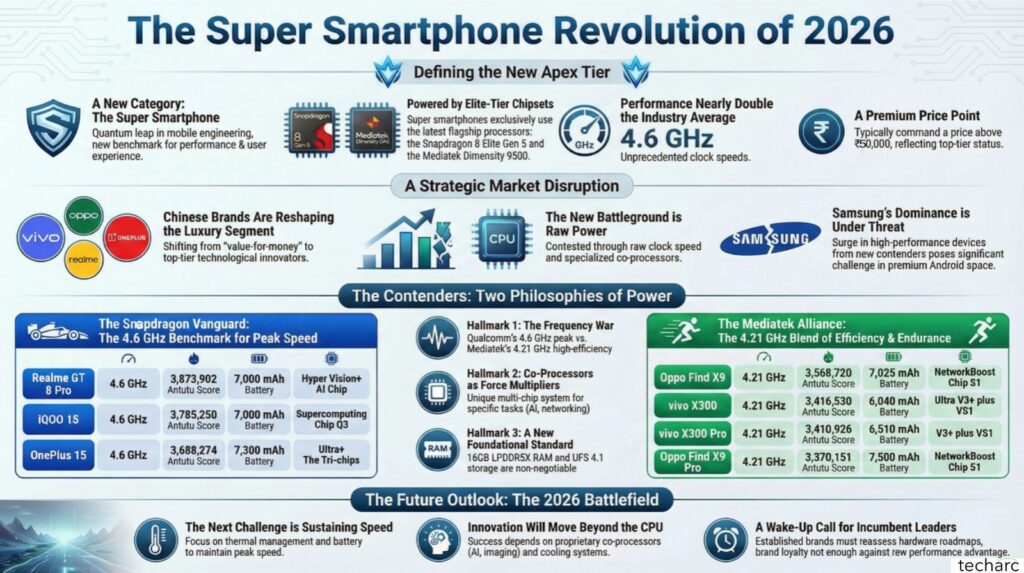
The advent of the super smartphone is not merely an evolutionary step; it is a catalyst for a seismic restructuring of the luxury smartphone segment. This trend represents a fundamental business disruption that challenges the established hierarchy of mobile brands. It signals a new era where raw clock speed and specialized hardware have become the primary battleground for market dominance, forcing a re-evaluation of brand positioning and value propositions across the industry.
This shift is spearheaded by a strategic pivot from prominent Chinese brands, including Vivo, Oppo, OnePlus, and Realme. Historically recognized for their value-for-money offerings, these manufacturers are now leveraging their maturing R&D capabilities to compete directly in the luxury smartphone segment. By pushing clock speeds to the theoretical limit, they are challenging incumbents on technological innovation, transitioning from mid-range disruptors to formidable contenders at the top tier.
The competitive implications are profound. This surge in high-frequency, high-performance devices poses a significant challenge to Samsung’s dominance in the premium Android space. While iPhone users remain relatively insulated due to ecosystem loyalty, the compelling proposition of super smartphones offering significantly higher raw processing metrics poses a growing challenge. This diversification sets the stage for a new competitive battleground in 2026, fought on the technical foundations of these powerful new devices.
2.0 The Devices that Qualify for the Super Smartphones Throne
We at Techarc have identified 7 devices under the super smartphone category, defined by a fierce rivalry between two semiconductor giants: Qualcomm and Mediatek. The flagship chipsets Snapdragon 8 Elite Gen 5 and Dimensity 9500 provide the foundational power. The following analysis examines how each brand leverages these platforms, specifically focusing on clock speed as the critical performance differentiator.
2.1 The Snapdragon Vanguard: The 4.6 GHz Benchmark
The devices powered by the Snapdragon 8 Elite Gen 5 chipset are engineered to deliver peak computational velocity. Characterized by a unified, industry-leading 4.6 GHz clock speed, these smartphones are built for users who demand the absolute highest frequency for single-thread performance and burst processing.
| Brand & Model | Chipset | Antutu Score | Clock Speed | Battery (mAh) | Proprietary Co-Processor |
| Realme GT 8 Pro | Snapdragon 8 Elite Gen 5 | 3,873,902 | 4.6 GHz | 7,000 | Hyper Vision+ AI Chip |
| iQOO 15 | Snapdragon 8 Elite Gen 5 | 3,785,250 | 4.6 GHz | 7,000 | Supercomputing Chip Q3 |
| OnePlus 15 | Snapdragon 8 Elite Gen 5 | 3,688,274 | 4.6 GHz | 7,300 | Ultra+ The Tri-chips |
| Oppo Find X9 | Dimensity 9500 | 3,568,720 | 4.21 GHz | 7,025 | NetworkBoost Chip S1 |
| vivo X300 | Dimensity 9500 | 3,416,530 | 4.21 GHz | 6,040 | Ultra V3+ plus VS1 |
| vivo X300 Pro | Dimensity 9500 | 3,410,926 | 4.21 GHz | 6,510 | V3+ plus VS1 |
| Oppo Find X9 Pro | Dimensity 9500 | 3,370,151 | 4.21 GHz | 7,500 | NetworkBoost Chip S1 |
2.1.1 iQOO 15
The iQOO 15 firmly establishes its Super Smartphone title through a potent combination of high-frequency processing and specialized hardware.
- Elite Clock Speed: The device leverages the 4.6 GHz capability of the Snapdragon 8 Elite Gen 5, driving an Antutu score of 3,785,250. This frequency allows for rapid instruction execution, essential for real-time processing.
- Specialized Processing: Its key differentiator is the Supercomputing Chip Q3, a dedicated co-processor designed to offload specific tasks from the main CPU, allowing the primary cores to maintain their peak 4.6 GHz frequency for longer durations without thermal throttling.
- Foundation: Supported by 16GB LPDDR5X RAM and a 7000 mAh battery, the device ensures that high-speed processing does not compromise daily endurance.
2.1.2 OnePlus 15
The OnePlus 15 qualifies as a super smartphone by pairing the standard-setting clock speed with a unique multi-chip architecture.
- Engineered Power: Like its peers, it operates at a peak 4.6 GHz. However, it differentiates itself with the Ultra+ The Tri-chips system. This architecture is engineered for ultimate performance, achieving an Antutu score of 3,688,274.
- Sustained Throughput: The Tri-chip system suggests a focus on distributing the workload to maintain that high clock speed during sustained heavy usage.
- Endurance: It is equipped with an impressive 7300 mAh battery, one of the largest in its class, designed to support the energy demands of a processor running at such high frequencies.
2.1.3 Realme GT 8 Pro
The Realme GT 8 Pro utilizes the 4.6 GHz clock speed to achieve the top spot in synthetic benchmarks, positioning itself as the leader in raw computational output.
- Benchmark Champion: While sharing the same 4.6 GHz clock speed as the iQOO and OnePlus, the Realme GT 8 Pro optimizes its architecture to hit an Antutu score of 3,873,902—the highest in this comparison.
- Visual Intelligence: It combines this raw speed with the proprietary Hyper Vision+ AI Chip, suggesting a strategic focus on leveraging high clock speeds for AI-driven visual processing.
- Balanced Specifications: With 16GB LPDDR5X RAM and a 7000 mAh battery, it offers a stable platform for its record-breaking performance.
2.2 Mediatek: The 4.21 GHz Efficiency Alliance
The super smartphones powered by Mediatek’s Dimensity 9500 chipset deliver a potent blend of specialized technology and massive endurance. Operating at a slightly lower but highly efficient 4.21 GHz, these devices focus on balancing raw speed with battery longevity and specialized co-processing.
2.2.1 Oppo Find X9/Pro
The Oppo Find X9 series leverages the 4.21 GHz Dimensity 9500 across two distinct models, prioritizing connectivity and battery size over raw clock speed superiority.
- Performance Anomaly: The standard Find X9 achieves a higher Antutu score (3,568,720) than the Pro model (3,370,151), despite both running at 4.21 GHz. This suggests significant differences in software tuning or thermal headroom between the two chassis.
- Battery Dominance: The Find X9 Pro features a massive 7500 mAh battery, the largest in this analysis. This pairing of a 4.21 GHz processor with such a large battery creates a device built for maximum uptime.
- Connectivity Focus: Both models utilize the NetworkBoost Chip S1, optimizing data throughput to match the processor’s speed.
2.2.2 vivo X300/Pro
The vivo X300 series utilizes the 4.21 GHz clock speed to drive advanced imaging capabilities through a complex multi-chip setup.10
- Consistent Speed: Both the Pro and standard models utilize the 4.21 GHz Dimensity 9500, achieving consistent Antutu scores in the 3.4 million range.
- Tiered Co-Processing: The differentiation lies in the secondary silicon. The X300 Pro uses the V3+ plus VS1 system, while the standard model uses the Ultra V3+ plus VS1. This configuration indicates that vivo is using the 4.21 GHz headroom primarily to drive complex image signal processing.
- Battery Variance: The series offers a choice in form factor endurance, with the Pro housing a 6510 mAh battery and the standard model a 6040 mAh unit.
3.0 The Clear Leaders
| Performance Metric | Device | Key Specification |
| Raw Performance Leader | Realme GT 8 Pro | Highest AnTuTu Score: 3,873,902 |
| Clock Speed Leaders | Realme, iQOO, OnePlus | Highest Frequency: 4.6 GHz (Snapdragon 8 Elite Gen 5) |
| Battery Endurance Leader | Oppo Find X9 Pro | Largest Battery Capacity: 7500 mAh |
A direct comparison of specifications reveals clear leaders in key performance categories. The market has bifurcated into two distinct camps: those chasing maximum frequency (Snapdragon) and those prioritizing battery density and efficiency (Mediatek).
Leadership in the super smartphone category is defined by the trade-off between the absolute peak speed of 4.6 GHz and the endurance benefits of a slightly lower frequency paired with larger batteries.
4.0 Conclusion: The Three Hallmarks of a Super Smartphone
This InsightsPro analysis reveals that these devices are highly specialized instruments of technology. A clear blueprint has emerged that defines this new apex category, with Clock Speed now serving as a primary indicator of device capability.
- The Frequency War (4.6 GHz vs 4.21 GHz): The elite tier is defined by the clock speed battle. Qualcomm’s 4.6 GHz platform targets users demanding peak burst performance, while Mediatek’s 4.21 GHz platform offers a high-performance alternative that allows for varying battery configurations.
- Multi-Processors as Force Multipliers: High clock speeds require intelligent management. Every brand in this analysis uses a unique, named multi-chip system (e.g., Supercomputing Chip Q3, NetworkBoost Chip S1) to manage specific tasks, ensuring the main CPU’s cycles are reserved for the most demanding operations.
- The New Standard: 16GB RAM & UFS 4.1: To support processors running at speeds up to 4.6 GHz, the supporting infrastructure has been standardized. 16GB of LPDDR5X RAM and UFS 4.1 storage are now non-negotiable, ensuring data is fed to the processor fast enough to prevent bottlenecks.
5.0 Key Takeaways:
- Differentiation: The primary differentiator is now Clock Speed. The 4.6 GHz threshold separates the ultra-performance tier from the high-efficiency tier.
- Market Shifts: Chinese OEMs are leveraging these high-frequency chips to challenge the luxury sector, offering raw speeds that established incumbents struggle to match at similar price points.
- Outlook: In 2026, the battle will likely move beyond just hitting 4.6 GHz to sustaining it. Thermal management and battery technology will become critical as brands attempt to maintain these peak speeds for longer durations.
Footnote
- The AnTuTu scores for some devices were obtained through our in-house testing, while others were sourced from verified secondary platforms such as the official AnTuTu website.
- The variants of each device, featuring the highest RAM configurations, were considered for this analysis.
- Battery endurance results for select devices were measured under heavy gaming and performance testing conditions.
- All conclusions and insights presented were drawn after carefully considering the results from all conducted tests and evaluations.