




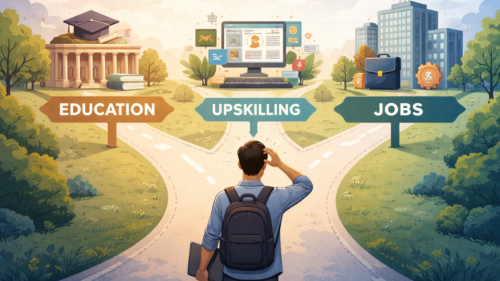
If education, upskilling platforms, and hiring requirements were people in a meeting, they’d probably all be talking at the same time—about completely different things. One would be discussing theory, another would be chasing the latest tools, and the third would be asking for “3–5 years of experience” from someone who graduated three months ago.
This disconnect isn’t just frustrating—it shapes how careers begin, stall, and sometimes restart. For most people today, a career doesn’t start with confidence; it starts with confusion. Despite years of education, the professional world often feels like a fresh start where everything suddenly seems new.
Let’s break down why these three pillars—college curriculum, upskilling, and job requirements—are rarely on the same wavelength, and what that means for real-world careers.
The College Curriculum: Built for Stability in an Unstable World
College curricula are designed with the best intentions: to build strong foundations, encourage structured thinking, and ensure students understand core concepts. The problem? The world they’re preparing students for no longer exists in a stable form.
Technology changes faster than academic committees can meet. By the time a curriculum is approved, printed, taught, examined, and revised, the industry has already moved on to newer frameworks, tools, and workflows. Students often graduate knowing why something works, but not how it’s used today.
For example, a computer science student may deeply understand data structures, operating systems, and databases—but still feel lost when a job posting asks for cloud deployment, CI/CD pipelines, containerization, and five specific libraries released in the last two years.
This doesn’t mean college education is useless—far from it. It builds problem-solving ability, discipline, and theoretical clarity. But it often stops short of translating knowledge into modern, industry-ready execution.
As a result, graduates walk into the job market fluent in theory but struggling to speak the practical dialect companies expect.
Upskilling Platforms: Chasing the Industry’s Moving Target
Enter upskilling—online courses, bootcamps, certifications, and weekend workshops promising to bridge the gap. Upskilling platforms move fast, adapt quickly, and speak the language of trends. Today it’s AI, tomorrow it’s something else.
On the surface, upskilling feels like the solution. Learn the latest tools, build a portfolio, get certified, and you’re “job-ready.” Except reality is a little messier.
Most upskilling focuses on tools, not context. Learners are taught what to use, but not always why, when, or at what scale. Many courses simulate ideal conditions—clean datasets, perfect requirements, and zero legacy systems. Real jobs rarely look like that.
There’s also an unspoken pressure to keep up endlessly. Finish one course, and three more are suddenly “mandatory.” The result is a strange paradox: people are constantly learning, yet rarely feel ready.
Upskilling has become less of a bridge and more of a treadmill—necessary, exhausting, and never quite finished.
Hiring Requirements: The Wishlist Problem
Now let’s talk about job descriptions—the most confusing literature modern professionals encounter.
Many hiring requirements read less like role expectations and more like a wish list assembled by multiple teams over time. One role, ten technologies, several years of experience, domain knowledge, soft skills, leadership ability, and the flexibility of a yoga instructor.
The irony? Many companies themselves train candidates after hiring them. Yet entry-level roles often expect candidates to arrive fully equipped, as if professional experience can be downloaded like software.
This creates a mismatch where companies search for “ready-made” professionals, while the ecosystem produces learners who are partially prepared in many areas but experts in none. Hiring filters then prioritize keywords over capability, narrowing opportunities for capable candidates who simply haven’t checked every box.
As a result, many careers begin not with confidence, but with imposter syndrome—despite years of effort and education.
Why Careers Feel Like a Fresh Start
Put these three systems together, and the outcome becomes clear: for most people, the start of a career feels like starting from scratch.
College teaches concepts. Upskilling teaches tools. Jobs demand execution in environments no one properly prepared you for. So when a new hire joins a company, they often relearn everything—processes, expectations, workflows, communication styles, and even how to “work” professionally.
This isn’t failure. It’s a structural issue.
The real world doesn’t operate in semesters or modules. It’s messy, fast, collaborative, and constantly evolving. No single system currently owns the responsibility of preparing individuals for this reality.
What’s needed is better alignment: Colleges integrating live industry problems and tool exposure; Upskilling focusing on decision-making, not just features and Hiring emphasizing learning ability over tool familiarity
Until then, most professionals will continue to experience their first job—and sometimes every new role—as a reset button.
And maybe that’s okay. In a world where technology reinvents itself every few years, adaptability might be the most valuable skill of all.
After all, if everyone is starting fresh anyway, the real advantage isn’t knowing everything—it’s knowing how to learn, unlearn, and laugh a little when the job description asks for “entry-level experience with 10 years of expertise.”