



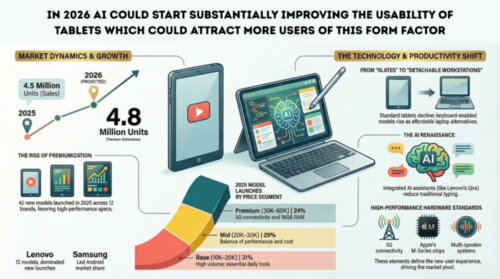
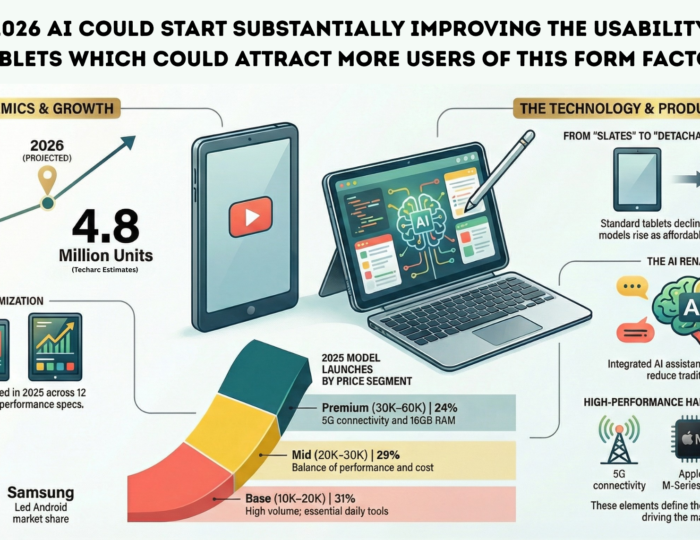
The tablets, even after 15 years, fail to strongly convincing masses of a use case. It has been one of the smart devices which has not grown in market size, unlike every other smart gadget or device. The Tablet market in India continues to struggle cross 5 million market. In 2025, our estimates suggest sales of around 4.5 million, which in 2026, could increase to 4.7-4.8 million units.
Tablets were seen as a very promising form factor in the enterprise and government sectors. Its use cases in education, healthcare, hospitality, government services, etc., could not convince to translate into a reality, and nothing significant could take off beyond pilot implementations.
On the consumer side, the only differentiation remained the screen size. However, getting more display real estate would mean a drastic dip in the experience as Tablets continued to be poorly specced as against smartphones. There was a remarkable dip in the experience as a user would buy a tablet in addition to a smartphone for a bigger screen.

Despite this, though the 1H’25 did not see many launches, the second of the year saw OEMs launching consumer Tablets reflecting their conviction in the form factor. The OEMs fundamentally started designing Tablets aligning with the specifications of smartphones to extend the experience and make it worth consuming heavy lift content like gaming.
Standard slate tablets saw a decline in favour of detachable keyboard models so that they could be positioned as an alternative to laptops. In India, a reasonably good laptop starts anywhere north of Rs 35-40,000, and OEMs saw this as an opportunity where keyboard enabled Tablets could be seen as affordable alternatives by consumers, especially students. The OEMs also preferred direct cellular connectivity in the form of 5G connectivity, making it an on-the-go connected device for real-time creation and consumption of content.
This report outlines the brand performances, market segmentation, and technological shifts defining the 2025 landscape.
1.0 Brand Performance
In 2025, a total of 42 new tablet models were launched across 12 brands. The market exhibited a distinct shift toward premiumization, with consumers prioritizing high-performance capabilities, AI integration, and larger displays.
- Lenovo: Lenovo led with 12 new launches, targeting value-conscious consumer segments while achieving the highest overall brand growth. A key innovation was the introduction of Qira, an AI assistant compatible with both Windows and Android. Lenovo also set a benchmark for media consumption with the Lenovo Tab Plus, featuring an 8-speaker JBL system.
- Samsung: Samsung followed closely with 9 model launches, leading the Android segment in overall market share. Key releases included the premium Galaxy Tab S10 and S10 FE series. Samsung also demonstrated strong performance in commercial sectors through high participation in education tenders.
- OnePlus: Secured the third position in the market with 6 model launches.
- Apple: Dominated the high-performance and premium tiers. Utilizing its proprietary M-Series silicon (M4 and M5 chips), Apple achieved the highest AnTuTu benchmark scores in the market, establishing the industry standard for raw processing power. The brand also achieved a record-breaking ultra-thin profile with the iPad Pro.
- Other Notable Brands: Xiaomi gained momentum through aggressive online pricing strategies, while Acer focused heavily on commercial and educational deployments.
2.0 Launch Patterns
Tablet launches in 2025 were highly targeted. Following a sluggish first half, Q3 witnessed the highest concentration of launch activity.
- Q1: 6 launches
- Q2: 11 launches
- Q3: 16 launches
- Q4: 9 launches
3.0 Price Segmentation Analysis
The transition toward premiumization is evident across price tiers. Detachable designs, 12GB RAM configurations, and 5G connectivity served as the primary growth engines. While the premium segment is experiencing the fastest growth, the base segment remains the primary driver of sheer volume.
- Entry Segment (Under 10K): Represented by brands like Lenovo and Domo, transforming basic tablets from luxury items into essential daily tools.
- Base Segment (10K–20K): Accounted for the highest volume at 31% of all 2025 launches (12 models).
- Mid Segment (20K–30K): Captured 29% of the market with 12 model launches.
- Premium Segment (30K–60K): Accounted for 24% of launches (11 models).
- Luxe Segment (Above 60K): Represented 12% of launches (5 models), exclusively driven by Apple (2 models) and Samsung (3 models).
4.0 Hardware Benchmarks by Segment
The following table outlines the standardized (mode) specifications expected within each price tier in 2025:
| Market Segment | RAM | Storage | Display Size | Battery Capacity |
| Entry (<10K) | 4GB | 64GB | 10.1″ | 5020 mAh |
| Base (10K–20K) | 8GB | 256GB | 11.0″ | 10000 mAh |
| Mid (20K–30K) | 8GB | 256GB | 11.0″ | 10200 mAh |
| Premium (30K–60K) | 16GB | 512GB | 10.9″ | 12140 mAh |
| Luxe (>60K) | 12GB | 256GB | 12.0″ | 11600 mAh |
4.1 Technology Life Cycle & Adoption Trends
4.1.1 Wax-Wane Analysis
- Emerging (Waxing): Wi-Fi 7, AI-integrated NPU support, and Bluetooth 6.0 are rapidly gaining momentum.
- Standardized (Mainstream): Wi-Fi 6/6E, Bluetooth 5.4, LCD displays, and 128GB storage are now baseline expectations.
- Declining (Waning): Wi-Fi 5, Bluetooth 5, and 64GB storage capacities are fading.
4.2 Core Hardware Advancements
- Processors: MediaTek and Qualcomm captured almost 76% of the chipsets, segmenting their offerings between high-end productivity/gaming chips and efficient budget processors. Apple (M and A series) leads in unparalleled raw performance.
- Audio & Visual: Multi-speaker configurations have become a standout hardware trend (e.g., Lenovo’s 26W stereo sound). Dolby Atmos tuning is now a universal standard across major brands. Concurrently, OLED displays are gaining traction for their extreme brightness and outdoor visibility.
- Portability: Ultra-thin chassis designs, seamless 5G connectivity for independent web access, and rapid-charging capabilities are essential features enabling the laptop replacement trend. AI integrations, such as Samsung’s Galaxy AI and Lenovo’s Qira, are heavily utilized for productivity tasks like real-time translation.
5.0 The Make in India Impact
The Make in India initiative transitioned from a monitoring phase to active enforcement in 2025.
- Policy Shifts: The government tightened import authorizations effective January 2026. Simultaneously, the PLI 2.0 scheme is actively providing financial incentives to 27 companies to boost local production.
- Supply Chain Response: Major contract manufacturers, such as Dixon Technologies, have rapidly scaled operations to assemble devices for brands like Lenovo and Xiaomi, mitigating import hurdles.
- Pricing Impact: Local manufacturing hubs have facilitated a slight price drop in entry-level tablets. However, premium tablets remain expensive as complex global supply chains undergo necessary calibrations. This infrastructure is paving the way for more value-oriented brands to enter the market with localized products.
6. Conclusion and 2026 Outlook
Despite a year-over-year decline in total shipments compared to 2024, the Indian tablet market successfully pivoted in 2025 from casual media consumption devices to productivity-first workstations. This was evidenced by the massive Q3 surge, the adoption of 5G, and the dominance of premium, high-performance hardware from Apple, Lenovo, and Samsung.
Looking Ahead to 2026: The market is entering an AI Renaissance. Moving into 2026, tablets will increasingly function as ecosystem-centric platforms heavily reliant on integrated AI assistants. This would make Tablets more accessible in the sense that it would be easy for consumers to interact with this form factor, reducing the present need to type, which many consumers still aren’t convinced tablets are well equipped to handle.
The roadmap is highlighted by highly anticipated hardware iterations, including further M4/M5 deployments from Apple and advanced ecosystem launches from Samsung. Furthermore, the maturation of the Make in India initiative will establish local assembly as the standard business model for global brands looking to maintain competitive pricing in the region.