





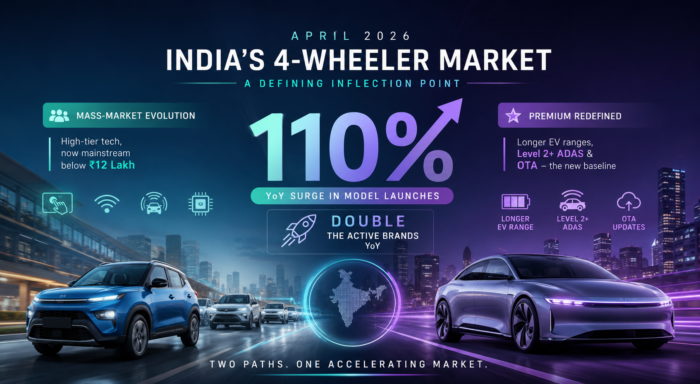
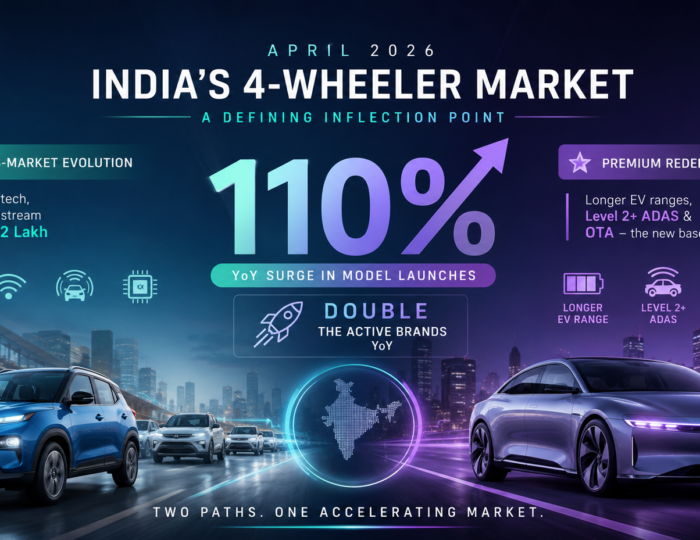
April 2026 marked a major inflection point in India’s 4-wheeler launch calendar, delivering an unprecedented 110% year-on-year surge in model launches. The month characterised by an intensifying competitive landscape as the market attracted double the number of active brands compared to the previous year. The core takeaway from this period is a visible bifurcation of the market: a mass-market rapidly absorbing high-tier tech features below ₹12 Lakh, and a premium segment where extended electric vehicle (EV) ranges, Level 2+ ADAS, and over-the-air (OTA) software capabilities are setting a brand-new baseline.
Key Takeaways
- Launches doubled year-on-year to 21 models, dividing the market into feature-packed budget cars under ₹12 Lakh and premium, ultra-tech vehicles.
- ADAS transitioned from a luxury perk to a standard baseline, featuring in 76% of launches, including mass-market models starting under ₹10 Lakh.
- EVs secured a 19% share after two years of zero April activity, marked by Tesla and VinFast’s entry and a massive 792 km range benchmark from Mercedes.
- Over-the-air (OTA) updates (81%) and connected car apps (91%) became baseline requirements for market relevance rather than premium add-ons.
Volume, Cadence, and Segment Mix Shift
While April typically experiences a shift in momentum after the first quarter, the month held its ground as a commercially significant window with 21 model launches, pushing past the combined counts of April 2024 and 2025. This indicates that automotive brands are actively front-loading the second quarter with tech-heavy vehicles to capture summer purchase intent.
The segment distribution reveals a premium-heavy outlier for the month. The D-segment, comprising large SUVs and premium sedans like Land Rover, Mercedes E/C-Class, and Audi A6, claimed a leading 38% share of the monthly launches, a staggering leap from the Q1 2026 monthly average of just 7%. Simultaneously, the mass market sustained its momentum in the B-segment with 6 compact SUV launches, including the Kia Syros, Volkswagen Taigun, and Hyundai Venue variants. The month also highlighted India’s widening EV import window, marked by the official April debuts of global players Tesla and VinFast.
The Democratisation of Advanced Driver Assistance Systems (ADAS)
The single biggest technological story of April 2026 is the rapid transition of ADAS Level 2 from a premium luxury differentiator to an industry-wide baseline expectation. Level 2 and Level 2+ ADAS featured in 76% of all launches this month, compared to a mere 20% adoption rate in April 2025.
Breaking down the 21 launches further, 14 models featured Level 2 capabilities, while 2 premium models introduced Level 2+ ADAS to the Indian market. This Level 2+ class, led by Tesla Autopilot and Mercedes DRIVE PILOT, introduces hands-free capability under defined conditions, representing a major leap forward for local consumer tech. Crucially, the technology has trickled down completely to the mass market, appearing in highly accessible options like the Hyundai Venue at ₹9.7 Lakh and the Kia Syros at ₹10 Lakh.
The Software-Defined Vehicle and Connected Car Features
Software-driven features have officially transformed into hygiene factors, standard elements that are necessary to compete rather than unique selling points. Connected car applications have reached near-universal penetration at 90.5%, climbing steadily from previous years. Similarly, voice control and cruise control have stabilized at leading levels across almost all non-base variants.
Furthermore, over-the-air (OTA) update capabilities crossed the 80% threshold this month. This steady consistency reflects a growing manufacturer and consumer comfort with software-defined vehicles, ensuring that the cars launched today can continuously adapt and improve over time. 360° cameras saw a slight downward dip to 71.4% of launches, though this is attributed purely to the high mix of entry-level trims introduced during the month rather than a rollback of the technology.
Breakthroughs in the Electric Vehicle Trajectory
April 2026 rewrote the historical script by capturing a 19% EV share in a month that recorded absolutely zero electric vehicle launches in both 2024 and 2025. The new EV cohort actively spans both mass-market and luxury price brackets, ranging from ₹24 Lakh to ₹64 Lakh. Notable entrants included the VinFast VF MPV, Hyundai IONIQ 5, and the Tesla Model Y Long Range.
The crowning achievement for the EV segment this month belongs to the Mercedes CLA EV, which introduced a certified range of 792 km. This performance sets a brand-new industry benchmark and proves that range anxiety is quickly becoming a legacy concern in the premium automotive segment. This milestone is expected to create a cascading effect, forcing mid-range EV manufacturers to urgently optimise their tech and battery efficiencies to stay competitive.
Outlook
The competitive landscape over the next 12 months will be heavily defined by how these two distinct market trajectories evolve. For vehicles under the ₹12 Lakh mark, success will depend on how quickly brands can bundle advanced software features, connected apps, and Level 2 ADAS as standard packages. In the premium space, the baseline has moved to 700+ km range electric powertrains and conditional hands-free driving. Manufacturers will need to align their product pipelines with these elevated consumer benchmarks to maintain relevance in an increasingly tech-forward market.