



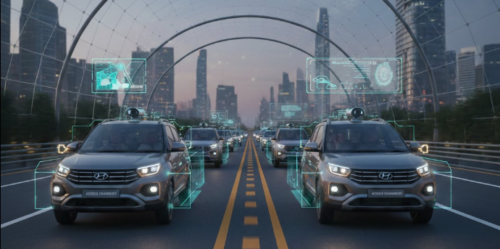
India’s roads are a battlefield. In 2025, the Ministry of Road Transport and Highways (Indian Express, quoting MoRTH) reported a staggering 134,307 accidents and 57,482 fatalities on National Highways alone, despite stricter helmet laws and seatbelt campaigns. But who is behind the wheel? Mostly, every day families in cars priced between ₹5-15 lakh, the segment accounting for 62% of India’s passenger vehicle sales (SIAM data). While luxury OEMs flaunt ADAS wizardry and premium sedans get crash-tested to oblivion, this mass-market backbone gets crumbs: dual airbags and ABS as passive afterthoughts. The real game-changer, active safety tech that stops accidents before they start, is locked behind a ₹20 lakh paywall.
It’s not hyperbole. In a nation where 70% of fatalities stem from human error like speeding, distraction, and fatigue (per IIT Delhi’s 2025 road safety study), OEMs are celebrating horsepower and infotainment while ignoring prevention. Safety has become a luxury tax, reserved for the top 1%. But as smartphone makers like Xiaomi and Realme democratized flagship cameras for the masses, why can’t Maruti Suzuki, Hyundai/Mahindra, or Tata do the same for life-saving tech? In this blog, we will be breaking down the luxury benchmark, exposing the gap, and proposing a roadmap to make active safety universal.
The Luxury Benchmark: Tech That Outsmarts Human Folly
Premium cars don’t just survive crashes, they pre-empt them. Here’s what the elite enjoy, powered by sensors, AI, and connectivity that could slash India’s fatality rate by 30-40% if scaled (World Bank estimates).
Predictive Protection: Genesis GV80’s radar-based rear occupant alerts ping your phone if a child is left behind, while Toyota Camry’s Proactive Driving Assist (PDA) auto-adjusts cornering speeds and tailgating distances using LiDAR and cameras. In India, the Toyota Innova Hycross offers a diluted version above ₹25 lakh.
Illumination as Safety: Audi Q7’s Digital Matrix LED headlights selectively dim for oncoming traffic, turning midnight highways into daylight. Mercedes-Benz’s EQS uses navigation-linked adaptive cruise control to preemptively brake for curves. Contrast this with the Hyundai Creta’s basic halogens; no wonder night accidents spiked 12% in 2025 (MoRTH).
Infrastructure Awareness: Hyundai IONIQ 6 and Honda Civic Hybrid deploy traffic sign recognition (TSR) and intelligent speed assistance (ISA), enforcing limits via gentle nudges or hard caps. BMW’s iX even predicts potholes using crowd-sourced maps. Yet, in the ₹10 lakh Hyundai Venue, you’re flying blind without these.
The Mass-Market Neglect: A Recipe for Disaster
The 5-15 lakh segment (think Maruti Brezza, Tata Nexon, Hyundai Venue, Kia Seltos) dominates with 4.5 million annual sales. Yet only 15% offer even Level 1 ADAS like basic collision warnings (JATO Dynamics). Adding radar costs ₹20,000-50,000 per unit, eroding razor-thin margins. Regulatory lag: Bharat NCAP mandates only passive safety till 2027. Buyers prioritize mileage and AC over invisible tech.
But stats scream urgency, 40% of accidents involve young drivers under 25 (Passive airbags save lives post-impact, but active tech prevents the impact. China’s BYD Atto 3 packs Level 2+ ADAS standard at ₹15 lakh equivalent, cutting urban crashes 35% in Beijing trials.
A Vision for Universal Safety: 5 Actionable Proposals for OEMs
OEMs, listen up: Shift from survive the crash to avoid the crash. Here are five feasible, tech-driven interventions, drawing from smartphone connectivity and AI trends, to standardize in every 5-15 lakh car by 2028. We have included costs, implementation hurdles, and Indian-market tweaks for realism.
- Remote Speed Governance via App
Parents shouldn’t dread teens borrowing the family Swift. Integrate telematics (already in 40% of new cars via IoT modules like Tata’s iRA) for app-based speed caps. Set 60 km/h for valets/minors; the ECU limits throttle response, regardless of pedal mash. It will cut speeding fatalities.
- Democratizing Level 2 or 3 ADAS
Level 2 (e.g., adaptive cruise in Creta SX) needs constant eyes-on. Level 3 hands full control in highways/geofenced zones, intervening on fatigue via eye-tracking cams. Use cheaper vision-only systems like Mobileye’s EyeQ6 Ultra (₹15,000/unit). Models like the Hyundai Venue (2025/26) and Honda Amaze have started bringing Level 2 ADAS under ₹15 lakh. It can be limited to NH corridors first, partnering with NHAI for HD maps. Tata’s Harrier EV could pioneer at ₹12 lakh.
- AI Face ID Dashcams
Factory-fit 1080p dashcams (₹3,000, like Realme’s budget cams) with edge AI (MediaTek Dimensity chips) scan faces at startup. Unregistered driver? Live feed and GPS ping to the owner’s phone via cloud. Thwarts 15% of minor-driven accidents (IRF data).
- Request Access Biometric Entry
Ditch fobs for capacitive fingerprint sensors on door handles (₹2,000, like Vivo phone tech). Unauthorized scan? Doors stay locked, the owner gets an approval push via app with facial verification. The pros of it are that it will zero down joyriding (5% urban thefts); kids can’t sneak out.
- Biometric Smart Cards for Ignition
NFC cards with embedded fingerprint chips (₹1,500, like contactless payments) slot into a dash reader. No match? No crank. Pair with app for multi-user profiles. Qualcomm’s Secure Access tech is already in PWAs. Maruti’s WagonR could add for ₹50k fleet savings. It will end found key mishaps; Singapore trials cut unauthorized starts 95%.
The Road Ahead: From Vision to Mandate
Implementing these isn’t charity; it’s smart business. Post-Bharat NCAP, safety boosts resale 20% (CarDekho data). Globally, Tesla’s FSD subscriptions rake billions; India could follow with ₹999/month Safety Pack. Government nudge: Tie PLI scheme incentives to active safety adoption, like Europe’s Euro NCAP 7-star push.
Safety isn’t a luxury, it’s equity. A life in a ₹7 lakh Brezza matters as much as in a ₹1 crore Fortuner. OEMs like you, Hyundai, and Tata: Prioritize prevention over pixels. India’s 2025 toll is a wake-up call.
In 2026, safety is no longer a spec-sheet filler; it is a brand’s moral compass. If a smartphone can lock out a stranger in milliseconds, a 1,500kg machine capable of 120km/h must do the same. The 5-15 lakh buyer isn’t asking for luxury; they are asking for the right to return home.