


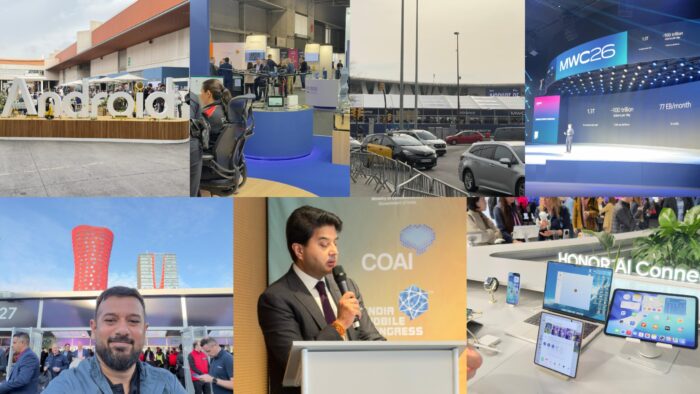
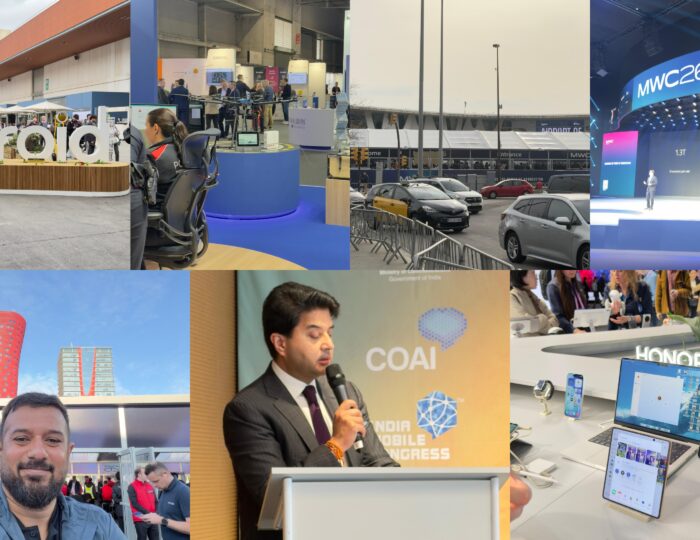
This special edition of tw@ta brings to you the key takeaways as well as identifies some of the very interesting showcases of technologies at the recently concluded Mobile World Congress, Barcelona 2026.
The special feature captures the essence of the event through an analyst’s perspective taking readers through the main happenings that will have long term implications on the industry and beyond. The diary does not essentially capture trends, which shall be explained in blogs, etc., in coming days.
Here are some of the key noteworthy themes about MWC 2026.
The AIR Era: Why AI and Robotics are the New Interface of Human Existence
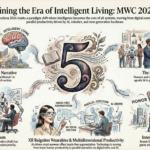
For two decades, the Mobile World Congress (MWC) in Barcelona has served as the heartbeat of the global connectivity ecosystem. It is the premier stage where senior leaders, government officials, and technical visionaries gather to amplify industry acumen and celebrate technical excellence. However, the 2026 summit marked a definitive departure from the past; the attendees of 207 countries participated in the event. While previous years were characterized by a push agenda, forcing specific hardware iterations or bandwidth upgrades (like the transition from 4G to 5G) this year introduced a seamless convergence of technologies.
We have officially entered the AIR Era: AI and Robotics. This is no longer a speculative future; it is the current interface layer of human existence. The underlying infrastructure, 6G, satellite networks (NTN), and quantum-ready data centers, now serves as a silent utility, while AI and Robotics act as the visible, tangible interface between humans, their surroundings, and the digital world. For nations like India, this represents a critical juncture: a choice between leading the design of these interfaces or once again becoming a secondary consumer market.
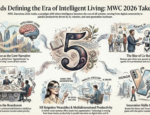
1. The Four Pillars of the IQ Era
The theme of MWC 2026, The IQ Era, reflects a shift toward connected intelligence. This era is supported by four strategic pillars that define how technology is developed, deployed, and debated:
1.1 Iconic Thinking: This pillar moves beyond technical ingenuity to address the brightest voices in policy, ethics, and industry. It acknowledges that as AI becomes agentic (capable of autonomous decision-making), the baseline for success is no longer just what we can build, but how it aligns with human values.
1.2. Big Ideas: This serves as the launchpad for the world’s most innovative startups. Here, tech creators demonstrate progress to leading investors and venture specialists, moving from laboratory prototypes to market-ready solutions that solve real-world complexities.
1.3. Latest Tech: This is the playground for digital futurists. It focuses on the products and services that will become ubiquitous within the next twelve months, transitioning from cutting-edge to essential.
1.4. Global Change: At the unique intersection of ministerial programs and business leadership, this pillar ensures that the digital dividend is shared. It focuses on creating a world where no one is left behind, emphasizing that connectivity must empower rather than exclude.
2. Strategic Industry Themes: Mapping the AI Convergence
The IQ Era is subdivided into six specialized themes that illustrate how AI is re-wiring every sector of the global economy:
2.1. AI 4 Enterprise
Data is no longer a byproduct of business; every organization is now a data company. This theme focuses on pragmatic, sector-specific intelligence. Key applications include:
Predictive Maintenance: Using AI to foresee factory floor failures before they occur.
Fintech Security: Real-time fraud prevention using high-speed inference.
Agentic AI: Transitioning from simple automation to AI agents that can empower the workforce by handling complex, multi-step tasks autonomously.
2.2. AI Nexus
This is the collision point for Generative, Multimodal, and Quantum-enhanced AI. As these technologies converge, the industry is grappling with:
Hyper-Personalized Experiences: Moving beyond generic algorithms to interfaces that understand individual intent.
Sovereign AI Stacks: The rise of national AI infrastructures to protect domestic data and maintain digital independence.
Governance Frameworks: Balancing the obligations of AI development with the opportunities it presents.
2.3. ConnectAI
The telecommunications sector is evolving into an AI Native Telco. Networks are gaining brains as well as bandwidth.
Edge Inference: Moving AI processing away from centralized clouds and directly to the edge, enabling ultra-low latency for robotics.
Self-Optimizing Radios: AI-driven automation of network slicing and planning to maximize efficiency and generate fresh revenue streams.
2.4. Game Changers
This theme looks at technologies poised to redraw industry boundaries:
Space-Borne Networks: Expanding connectivity to the most remote corners of the Earth via satellite.
Next-Gen Interfaces: Moving beyond the glass screen to haptic, spatial, and neural interfaces.
Moon-shot Materials: Using AI to discover new materials for better battery chemistry and structural integrity.
2.5. Intelligent Infrastructure
Connectivity is being transformed from a cost center into a strategic value platform. Next-generation networks are utilizing AI-driven automation and open architectures to build a digital backbone that is resilient, scalable, and low-carbon.
2.6. Tech4All
Inclusive innovation remains the ultimate goal. This theme debates the policies needed to ensure the Global South has access to resilient national digital infrastructures, climate-tech, and digital literacy.
3. The Indian Context: Reclaiming the Future
A candid introspection of India’s technological trajectory reveals a recurring pattern of missing the bus. Despite a massive consumer base, India lacked a dominant global brand in the smartphone era, struggled with high-value addition in wearables, and failed to capture the consumer electronics market at the right inflection point.
The Risk: The AIR wave is not a short-term trend; it is a decade-long evolution. If India fails to capture the AIR opportunity in 2026, it risks being sidelined until 2035 or beyond.
3.1 The Strategy: Localization of Form and Function
India requires:
Cultural Aesthetics: Robots must be culturally fit. A humanoid’s appearance and interaction style in Barcelona may feel alien in Bengaluru.
The Self-Service Paradox: India has not historically embraced self-service (kiosks, self-check-ins). There is a cultural preference for presence.
Local Use Cases: Instead of replacing humans with kiosks, India should explore Robotic Presence. For example, a humanoid Doorman or receptionist in a hotel maintains the traditional hospitality feel while leveraging the efficiency of AIR technology.
3.2 The India Pavilion at MWC Barcelona 2026
The presence of Telecom Equipment and Services Export Promotion Council (TEPC) at MWC underscores India’s commitment to the IQ Era pillars, specifically Global Change and Latest Tech. By positioning itself as a provider of Secured & Reliable equipment, India is addressing the global demand for Data Sovereignty and Sovereign AI stacks. This pavilion is a physical manifestation of the Fast-Track specialised framework needed to ensure India does not miss the AIR opportunity.
For India an important event was also the curtain raiser of India Mobile Congress 2026, which was unveiled by the honourable Union Minister for Communications and Development of North-Eastern Region, Shri Jyotiraditya M. Scindia.
An important feat achieved by India at MWC 2026 was CDOT’s innovation being shortlisted for prestigious GLOMO awards in the best solution for fraud prevention category. This is for the first time that a purely Indian organisation’s entry was shortlisted for the coveted awards.
4. Roadmap for Action: The Fast-Track Framework
To avoid the slow-moving nature of past initiatives, India must adopt a specialized framework:
Specialized Entity: Move beyond generic hackathons. India needs a dedicated, fast-track body (a National AIR Mission) that can drive development with the speed of a startup but the scale of a nation.
Global Outlook: Domestic startups must look beyond local consumption. The goal is to create products with global utility and acceptance, built on a foundation of Indian IP.
Paced Innovation: The journey to 2030 is short. Innovation must be accelerated to meet the window of opportunity.
Design Sovereignty: Investment must be poured into the appearance and industrial design of robots, ensuring they fit the unique ergonomic and social needs of the Indian population.
5. Our Select Innovations: Proof of Concept from MWC 2026
The following devices exemplify the current state of the AIR era and provide a blueprint for localized innovation:

This device integrates a physical robotic gimbal camera arm into the handset. It allows the phone to track subjects autonomously for hands-free, cinematic video. It is a prime example of a physical bot replacing a software-only solution, though it highlights the need for specialized engineering to ensure the durability of moving parts.
5.2. The Tecno Atom (Modular Phone)
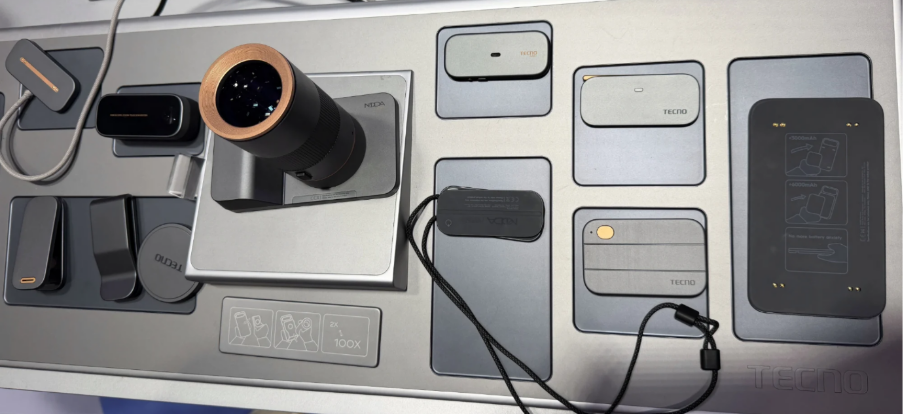
At just 4.9mm thin, this portless device uses a magnetic system to snap on specialized hardware, such as 3x optical zoom lenses or stackable battery packs. It proves that modularity can be sleek and functional, potentially reducing electronic waste by allowing users to upgrade modules instead of the whole device.
5.3. Xiaomi Vision Gran Turismo
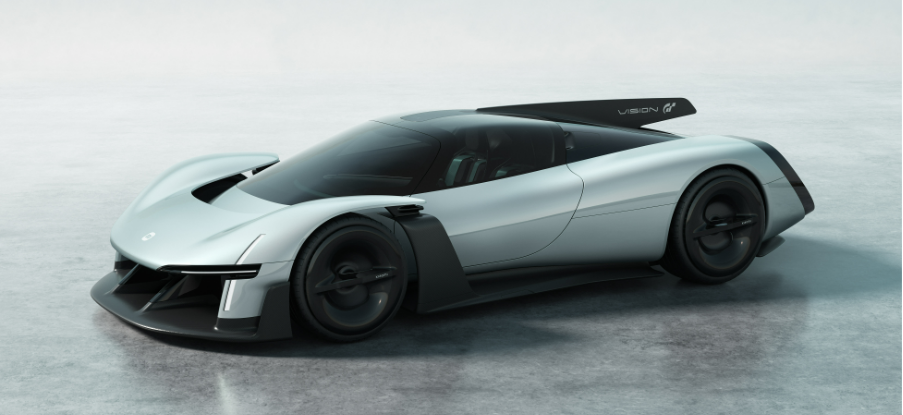
The Xiaomi Vision Gran Turismo is a full-scale electric hypercar concept that marks a historic collaboration between Xiaomi and the legendary Gran Turismo franchise. As the first technology company invited to the Vision GT project, Xiaomi has applied its ecosystem-driven philosophy to automotive design, resulting in a vehicle that balances extreme aerodynamics with high-end intelligence. The concept is defined by its Sculpted by the Wind exterior, achieving a drag coefficient of just 0.29 while generating significant downforce without traditional add-on spoilers.
5.4. The vivo Vision

This 398g mixed-reality headset represents the peak of spatial computing. With dual 8K Micro-OLED displays and a 120-foot virtual screen experience, it functions as both a Giant Mobile Cinema and a high-precision productivity tool. Its low latency (13ms) passthrough ensures the virtual and physical worlds remain synchronized.
5.5 The Lenovo ThinkBook Modular AI PC
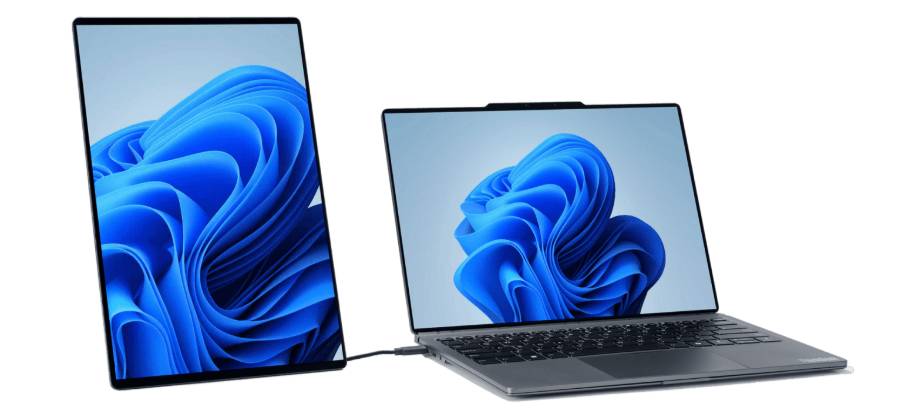
This 14-inch concept features a detachable secondary display and modular I/O ports. It allows professionals to carry small and use big, rearranging the screen layout to suit portrait or landscape needs, a perfect tool for the AI-driven, flexible workspace.
6. Perspectives
6.1. HFCL’s Quiet Transformation into a Networking Powerhouse
For years, HFCL was largely perceived as an optical fiber company, an infrastructure supplier operating quietly behind the telecom ecosystem. But that narrative is increasingly outdated. The company is undergoing a structural transformation, positioning itself as a full-stack networking solutions provider rather than just a component manufacturer.
The shift reflects a broader ambition: to move from telecom infrastructure to end-to-end connectivity platforms.
Beyond Fiber: A Portfolio Transformation
HFCL today operates across multiple layers of network infrastructure. Its capabilities now include enterprise Wi-Fi systems, point-to-point radio networks, switching solutions, and 5G Fixed Wireless Access (FWA) devices, many of which are designed in-house.
One of the company’s most notable claims is that it has developed a fully designed 5G FWA customer premises device from scratch in India, retaining complete ownership of the intellectual property.
This approach matters. In an industry where many vendors depend heavily on external design houses, HFCL’s strategy focuses on controlling both hardware and software stacks, enabling faster product customization and tighter integration.
A Domestic Footprint with Global Aspirations
Within India, HFCL’s technology sits deep inside the digital infrastructure. Major telecom operators rely on its radio equipment for network backhaul, while universities, enterprises, and government institutions deploy its networking products.
Take University of Delhi as an example. The institution’s vast digital network, spanning dozens of colleges, hostels, and campuses, runs on HFCL’s Wi-Fi and switching backbone, serving hundreds of thousands of students.
Internationally, the company is quietly expanding. Its products are deployed in European stadium networks, African telecom infrastructure, and educational institutions abroad, while newer markets such as the Middle East are emerging as strategic growth opportunities.
The company currently derives the majority of its revenue domestically, but leadership expects international business to expand significantly over the next few years.
Competing in the Value Innovation Zone
HFCL does not compete as the cheapest vendor. Nor does it attempt to match the scale of industry giants.
Instead, the company positions itself in a value innovation zone, offering enterprise-grade capabilities comparable to established players like Cisco and Aruba Networks, but at a significantly lower cost structure.
The differentiator lies in customization.
Unlike larger vendors that deploy standardized solutions, HFCL often adapts its products to fit the operational needs of specific institutions. In complex deployments, such as large university campuses, this flexibility can be the deciding factor.
The Silicon Partnerships Behind the Products
Despite its growing design capabilities, HFCL still depends on global semiconductor ecosystems. Many of its Wi-Fi solutions are built around chipsets from Qualcomm, while switching platforms leverage silicon from companies such as Broadcom and Marvell Technology.
This hybrid model, Indian system design powered by global silicon platforms, is increasingly common in the networking industry.
A Bigger Question: Why So Few Indian Product Champions?
The conversation around HFCL inevitably opens a broader debate about India’s role in global telecom technology.
Despite decades of policy discussions around indigenization and technology leadership, the number of globally recognized Indian telecom product companies remains limited. Countries like China built massive ecosystems of vertically integrated technology firms, supported by deep manufacturing capabilities and long-term capital.
India, by contrast, still operates in a fragmented ecosystem.
Yet there are signs of change. Companies like HFCL are gradually building product-centric technology stacks, designing hardware, software, and manufacturing pipelines within the country.
The progress may be slower than many would like, but the trajectory is visible.
The Road Ahead
HFCL’s leadership sees the next phase of growth coming from home networking, enterprise Wi-Fi, and global distribution channels. The company has already begun listing its products on international e-commerce platforms, aiming to reach customers directly in markets far beyond India.
The long-term ambition is simple but ambitious: to build an Indian networking brand that competes globally, not just as a supplier, but as a recognized technology innovator.
In a sector dominated by American and Chinese giants, that journey will not be easy. But if companies like HFCL succeed, they could redefine how the world perceives India’s role in telecom technology.
6.2 MediaTek’s Real Strategy — Performance That Actually Matters
For years, the smartphone chipset industry has been obsessed with a single metric: peak performance. Benchmarks, clock speeds, and short bursts of power have often dominated marketing narratives. But according to MediaTek’s leadership, that approach misses how people actually use smartphones.
A smartphone is not a racing engine designed to deliver a few seconds of extreme output. It is a daily companion, handling gaming sessions, video calls, messaging, AI tools, productivity apps, and dozens of background processes throughout the day. What matters in that environment is not peak performance, but consistent performance over time.
MediaTek’s strategy reflects that belief. Instead of chasing momentary benchmark spikes, the company focuses on delivering stable performance, better thermal management, and longer battery life. The objective is simple: a phone that runs smoothly throughout the day without overheating or draining the battery.
This shift in philosophy has become increasingly important as smartphones evolve into AI-driven computing platforms. Modern devices are expected to run multiple applications simultaneously, often with AI models operating locally on the device. Under such workloads, sustained efficiency becomes far more valuable than short bursts of speed.
The market response suggests that the approach is working. MediaTek has maintained its position as the world’s leading smartphone SoC supplier for more than twenty consecutive quarters, with markets such as India seeing the company cross the 50 percent share threshold.
However, smartphones represent only one part of MediaTek’s broader growth story.
The company now operates across what it describes as a multi-growth era, where multiple business segments are expanding simultaneously. Beyond mobile processors, MediaTek has built strong positions in smart TVs, tablets, IoT devices, automotive platforms, and Chromebooks. In fact, the company has become a leading chipset provider for smart televisions and a dominant player in Chromebook processors.
A newer and potentially transformative opportunity is emerging in data center and AI computing. MediaTek has begun investing heavily in custom silicon designed for AI workloads and high-performance computing. The company expects this segment alone to generate billions of dollars in revenue within the next few years.
Partnerships are central to this strategy. MediaTek collaborates with a wide network of technology leaders across the semiconductor and device ecosystem. These partnerships span mobile device manufacturers, cloud infrastructure providers, and semiconductor manufacturing partners.
One example is the company’s collaboration with NVIDIA on advanced computing platforms. MediaTek has also been working with satellite connectivity providers to explore non-terrestrial network technologies, enabling devices to connect directly to satellites in areas where cellular infrastructure is unavailable. Such innovations could dramatically expand connectivity in rural and remote regions.
This collaborative approach reflects MediaTek’s corporate philosophy. Rather than focusing heavily on branding campaigns or sponsorship-driven marketing, the company emphasizes technology enablement, working behind the scenes to power devices used by millions of people.
The roots of that philosophy lie in MediaTek’s founding mission: democratizing technology. The company was built around the idea that advanced computing should not remain limited to premium devices or wealthy markets. Instead, it should be accessible to as many people as possible.
That vision is becoming even more relevant in the age of artificial intelligence.
AI is poised to transform industries ranging from healthcare and finance to education and agriculture. But the real impact will depend on whether these technologies become accessible beyond data centers and large enterprises. If AI remains confined to expensive cloud infrastructure, its societal impact will be limited.
MediaTek’s approach aims to address that challenge by enabling powerful yet efficient AI capabilities directly on consumer devices. Running AI models locally on smartphones and personal devices offers two major advantages: lower power consumption and improved privacy, since sensitive data does not need to leave the device.
This capability could unlock entirely new use cases. Personal health monitoring, financial assistance tools, and AI-powered education platforms could all operate directly on personal devices without relying entirely on cloud computing.
Looking ahead, the next wave of innovation may combine AI processing, satellite connectivity, and edge computing. In such a world, smartphones and personal devices could become powerful AI assistants capable of delivering advanced services even in areas with limited infrastructure.
That is the future MediaTek believes it is building toward, one where technology is not just faster, but more accessible, more efficient, and more inclusive.
In an industry often dominated by flashy launches and performance benchmarks, MediaTek’s strategy is quietly different. The company is less focused on winning the headline race and more focused on a deeper objective: enabling the next generation of computing for billions of people.
And if that vision materializes, the real competition in semiconductors may no longer be about who builds the fastest chip, but who enables technology at the largest scale.
7. Conclusion: The Window of Opportunity
The AIR era is the defining technology horizon for the next decade. It is a layer that will sit on top of our existing telecommunications infrastructure, interfacing with humans in ways we are only beginning to understand. India possesses the talent and the data, but it currently lacks the specialized focus and localized design strategy needed to lead.
We are in 2026. The year 2030 is approaching rapidly. If we do not establish a specialized framework for AI and Robotics today, we will once again find ourselves importing the future rather than building it. The choice is clear: lead the AIR era or be left behind in the wind.