



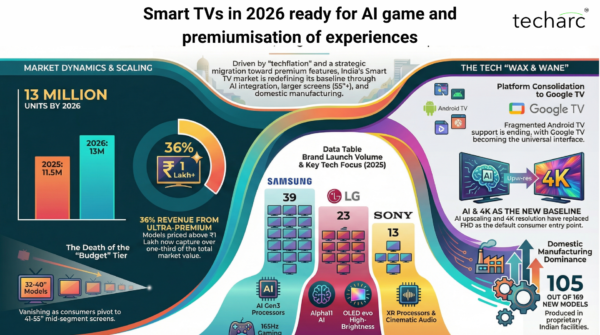
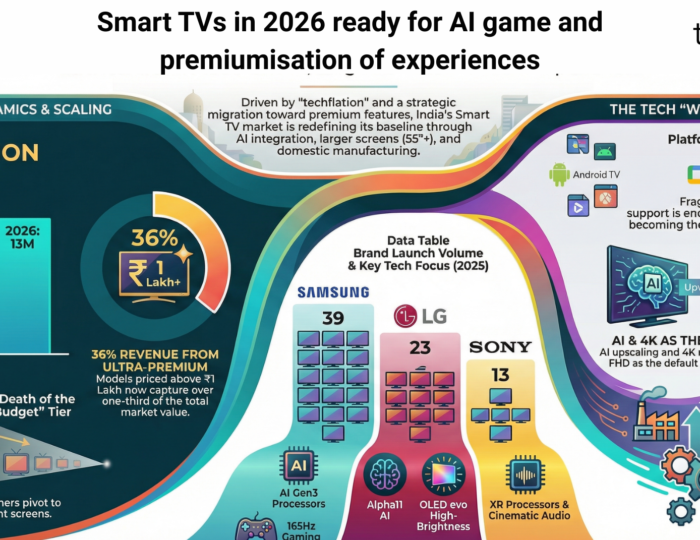
The Indian Smart TV sector reached a critical inflection point in 2025, recording estimated sales in the range of 11.5-12.5 million units driven by a widespread wave of techflation and premiumisation. In 2026, Techarc forecasts this figure to reach 12–13 million units. 2025 marked a decisive structural shift where consumer preference, incentivised by a strategic GST reduction on larger screens, migrated aggressively from compact budget models to premium, large-format experiences. Industry leaders Samsung and LG led the pace of innovation, normalising advanced features such as AI-driven upscaling, OLED displays, and high-refresh-rate panels across broader price points.
Simultaneously, the ecosystem witnessed profound operational consolidation. The software landscape aligned decisively under the Google TV interface, effectively ending the era of fragmented Android TV support. On the supply side, domestic manufacturing cemented India’s status as a self-reliant production hub, with proprietary facilities dominating the assembly line.
In 2025, the total number of smart TVs launched were 169 across 31 brands. This report dissects these strategic movements, highlighting how 2025 effectively redefined the market baseline, ushering in a new standard defined by immersive cinema, artificial intelligence, and sophisticated connectivity.
- Key Strategic Shifts:
- Platform Consolidation: A decisive transition toward Google TV as the preferred operating system. With legacy Android TV support waning (including changes to YouTube support protocols), 2026 is expected to be dominated exclusively by the Google TV interface.
- Experiential Premiumisation: Accelerated adoption of QLED and Mini-LED technologies, paired with AI-driven image processing for superior picture optimisation.
- Market Bifurcation: A clear divide has emerged between the volume-driven value segment and the technology-led premium segment.
2.0 Competitive Landscape: Top 5 Brands
Samsung and LG maintained their hold on the market, collectively driving innovation in the premium sector, while challenger brands disrupted the value segments.
2.1 Samsung: Samsung spearheaded the Indian market with 39 new Smart TV models, capturing 24% of total launches. The company solidified its leadership in the ultra-premium segment with the NQ4 AI Gen3-powered F series. Key portfolio highlights included the flagship 115-inch QA115QN90 Neo QLED and the S95F QD-OLED lineup, featuring advanced 144Hz/165Hz gaming capabilities.
2.2 LG: Securing the second spot in 2025, LG Electronics introduced 23 new models tailored for the Indian market. The company’s strategy pivoted toward high-performance visuals, anchoring its premium portfolio on high-brightness OLED evo panels powered by the advanced alpha11 AI processors. Key launches included the next-generation 5-series OLEDs (G5, C5, B5) and the expansive 86-inch QNED8G Mini-LED, reinforcing LG’s dominance in the large-screen segment.
2.3 Sony: Sony curated a focused lineup of 13 new models, cementing its stronghold in the high-end cinematic segment. The portfolio, led by the Bravia 8 II (XR80M2) and M5 series, leverages the XR Processor to deliver PlayStation-exclusive optimizations and industry-leading Acoustic Surface Audio technology.
2.4 Blaupunkt: Blaupunkt introduced 10 new models, strategically targeting the Affordable Premium segment. The brand differentiated its portfolio through high-value specifications, integrating signature Sonic Soundbars and high-refresh-rate 120Hz/144Hz panels to democratize premium features for the mass market.
5. VW: VW disrupted the value segment with a strategic rollout of 7 new models, democratizing access to large-format displays. The brand’s lineup is headlined by the 75-inch (BQD75Mini) and 85-inch (VW85GQ1) QLEDs, which bring premium Mini-LED technology and powerful 100W+ sound systems to entry-level price points.
3. Segmentation Analysis
By Screen Size & Price Tier
3.1 Entry Segment (Up to 32″): The entry-level segment recorded 19 launches. Standard configurations in this tier consolidated around 1GB RAM, 8GB storage, and 20W audio output. Manufacturers prioritized core functionality, maintaining a strict focus on affordability and mass-market accessibility.
3.2 Base Segment (32″–40“): The base segment registered negligible activity, recording just 4 launches. OEMs actively vacated this tier, pivoting their portfolios to prioritize larger screen formats.
3.3 Mid Segment (41″–55″) – Market Leader: The mid-segment dominated the landscape, recording the highest volume with 70 launches and capturing 41% of the market by screen size. Standard configurations consolidated around 2GB RAM and 16GB storage, typically paired with 20W audio. However, premium models in this tier differentiated themselves with powerful sound systems reaching 108W. This segment established itself as the definitive mass-market standard, shifting the narrative from basic specifications to lifestyle-driven branding.
3.4 Premium Segment (56″–75″): The premium segment closely trailed the mid-tier, recording 53 new launches. Often defined as the Lifestyle & Cinema category, standard audio configurations in this bracket remained stagnant at 20W, indicating a strategic reliance on the external soundbar ecosystem to complete the home theatre experience.
3.5 Luxe Segment (Above 75″): The Luxe segment remained a niche category, recording a focused lineup of 23 launches. This tier exclusively targeted ultra-high-net-worth individuals (HNIs) and dedicated home cinema enthusiasts.
Revenue Impact: The >₹1 Lakh price band captures approximately 36% of the total market value.
4.0 Wax-Wane Analysis
4.1 Emerging Technologies (WAX)
- Visuals: Increasing penetration of Mini-LED in premium (>₹50K) segments. 120Hz refresh rates are expanding beyond gaming niches into upper mid-range models.
- Connectivity: Aggressive expansion of Wi-Fi 6 and Bluetooth 5.3, preparing the ecosystem for high-bandwidth streaming.
- Hardware: Rechargeable Solar Remotes are becoming standard, replacing disposable batteries to meet sustainability goals.
- AI Integration: AI Upscaling and proprietary NPUs (Neural Processing Units) are moving from flagship exclusives to baseline standards.
4.2 Declining Technologies (WANE)
- Resolution: FHD (Full HD) is being phased out; 4K (UHD) is now the default consumer entry point.
- Legacy Connectivity: Bluetooth 4.2 is being replaced by 5.0. Single Band Wi-Fi 5 is vanishing and dual bands take place, and HDMI 1.4 is rapidly disappearing from mid and premium lineups and replaced by HDMI 2.1.
- Storage: 8GB storage is now confined strictly to entry-level models; 16GB is the new industry baseline.
4.3 Mainstream Standards (Mainstream)
- Display: 4K UHD @ 60Hz on QLED panels.
- Connectivity: HDMI 2.1, Dual Band Wi-Fi 5, and Bluetooth 5.0.
- Core Architecture: Quad-Core CPUs paired with 16GB Storage.
5. Technical Specifications Overview
5.1 Display & Visuals
- Resolution: 4K is the industry standard. 8K remains niche.
- Panel Tech: QLED is the most widely used technology in the launches, more than 64% of TVs featured QLED displays. Mini-LED adoption is rising.
- Refresh Rate: 60Hz is standard, with a strong shift toward 120Hz panels in premium tiers. VRR support (144Hz/165Hz) is increasingly common for gaming optimisation.
5.2 Audio Configuration
- Power Output: Highly standardised.
- 20W–30W: Mass-market standard.
- 40W–48W: Step-up offering.
- 60W+: Limited to select premium differentiators.
5.3 Dolby Support:
Dolby Atmos and Dolby Vision are now mainstream, appearing even in 20W mid-range models. Around 72% of the models launched in 2025 supported Dolby Atmos and half (50%) featured Dolby Vision.
5.4 Connectivity & Accessories
- Wi-Fi: Wi-Fi 5 (Dual Band) is the dominant baseline. Wi-Fi 6 is emerging in premium models. Single-band support is negligible.
- Bluetooth: Bluetooth 5.0 is the standard, with v5.3 becoming increasingly common for lower latency and stability.
- USB: USB-A (2.0) dominates; USB-C is rare (limited to v3.0/3.1).
- Remotes: Hybrid IR + Bluetooth with Voice Control (Google/Alexa) is the mainstream standard. Premium models differentiate via SolarCell technology and Magic motion controls.
5.5 Processor & Compute
- Architecture: Quad-Core CPUs (ARM Cortex A53/A55) are the universal industry baseline. There is no significant move toward higher core counts.
- Supply Chain: Dominated by third-party platforms, primarily MediaTek.
- Premium: Characterised by proprietary silicon branding (Samsung NQ, LG Alpha, Sony XR) to emphasise AI capabilities.
- Graphics (GPU): Low transparency in specs. Common units include ARM Mali-G31/G52. GPU power is generally treated as a support component rather than a differentiator.
6. Operational Insights
6.1 Launch Timing Analysis
Peak Activity: April and July were the strongest months (29 launches each), accounting for 34% of total annual launches.
6.2 Quarterly Trends: Q2 (Apr-Jun): Highest activity (75 launches; 44% of total). Q1 & Q3: Moderate activity (44 launches each). Q4 saw a significant slowdown (6 launches), with December recording minimal to zero activity.
6.3 Manufacturing & Assembly
- Domestic Dominance: Of 169 models analysed, 105 were produced in proprietary facilities.
- Imports: Only 13 models were imported. This shows India has solidified its position as a self-reliant production and assembly hub for the smart TV ecosystem.
7. Future Outlook & Conclusion
The 2025 data signal a maturing market characterised by techflation. As entry-level segments (sub-32″) shrink, the market floor is rising.
Forecast for 2026:
Forced Upgrade Path: Consumers will increasingly be pushed towards larger screens and higher price points as the base segment (32″-40″) starts vanishing.
Platform Homogeneity: The Google TV interface will likely achieve near-total saturation.
Economic Shift: The reduction in GST rates will continue to fuel the premiumisation of the average Indian household, normalising 55-inch+ screens as the new standard.
Final Note: The era of the compact, budget smart TV is ending. The future of the Indian market lies in larger, AI-integrated displays, necessitating increased consumer expenditure to access standard modern features.