


AI-Native Hardware, Premiumization, and Local Value Addition Define the Next Growth Cycle
Gurugram/Srinagar: The Indian consumer electronics market is entering a structural reset as it approaches 2026. Smartphones, laptops, tablets, and smart TVs once operating in silos are now converging under a unified, experience-first technology framework. The industry is shifting from volume-driven expansion to value-driven performance, powered by AI-native hardware and aggressive premiumization.
At the center of this transformation is techflation, a structural rise in average selling prices (ASPs) driven by high-performance features rather than pure inflation. Entry-level utility devices are gradually being deprioritized, while mid-to-premium configurations capable of supporting AI workloads and long-term performance consistency are becoming the new standard.
Click here to read the full report
AI as Core Infrastructure
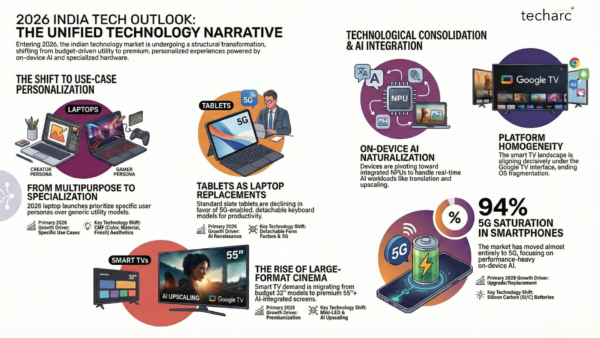
Artificial Intelligence has transitioned from a marketing differentiator to a foundational hardware requirement. Across categories, OEMs are integrating dedicated Neural Processing Units (NPUs) and proprietary chipsets to enable real-time image enhancement, battery optimization, adaptive performance, and voice-driven usability.
AI is no longer positioned as a luxury feature. It is now embedded infrastructure powering baseline functionality in smartphones, AI-PCs, and next-generation smart TVs.
Premiumization and the Forced Upgrade Cycle
A clear forced upgrade path is emerging. In smart TVs, sub-32-inch models are steadily exiting portfolios as consumers gravitate toward immersive 55-inch and above formats. Favorable GST adjustments and demand for home cinema experiences are accelerating this transition.
In smartphones and laptops, sub-₹15,000 entry tiers are under pressure as brands prioritize configurations that can sustain generative AI workloads. Higher RAM, advanced processors, and improved thermal management are redefining the minimum viable specification.
Consumer expectations have shifted from raw clock speeds to sustained peak performance, ecosystem integration, and device longevity.
New Technology Baseline
The industry is standardizing around advanced display and connectivity protocols. LTPO OLED, QLED, and Mini-LED panels are becoming mainstream across premium devices, delivering high brightness and cinematic color accuracy. Wi-Fi 6E and Wi-Fi 7 are establishing low-latency connectivity standards critical for AI and AR applications, while Bluetooth 5.4 and above enable secure tracking and seamless audio integration.
Legacy technologies such as Wi-Fi 5, Bluetooth 4.2, and 64GB storage are entering obsolescence. Meanwhile, 144Hz refresh rate panels and Silicon Carbon batteries are moving from niche to mainstream adoption.
Hardware Evolution and Cost Pressures
A global surge in High-Bandwidth Memory (HBM) demand driven by AI server infrastructure has increased memory prices by nearly 50% through late 2025. This has intensified the RAM-ROM squeeze, pushing 16GB RAM toward becoming the baseline for mid-to-premium laptops and advanced consumer ecosystems.
Processor competition is also intensifying. Intel’s dominance in laptops has softened, creating opportunities for Qualcomm’s Snapdragon X platforms and AMD’s Ryzen AI processors in AI-centric and ultraportable segments. Performance-per-watt and AI acceleration are emerging as primary competitive metrics.
Make in India: From Assembly to Value Addition
India’s electronics manufacturing ecosystem is transitioning from assembly-focused operations to deeper value addition. Smartphone CBU imports have declined sharply from $7.6 billion at peak to $442 million by 2024, setting a precedent for tablets and laptops, where local manufacturing crossed 25% in 2025.
Under the PLI 2.0 framework, component localization across displays, batteries, and semiconductors is gaining momentum. Manufacturing leaders such as Dixon Technologies are scaling production for global brands including Samsung, LG, Lenovo, and Xiaomi, reinforcing India’s strategic push toward higher domestic integration.
This long-term roadmap aligns with the Viksit Bharat 2047 ambition to move beyond assembly and build indigenous intellectual property capabilities.
Upgrade-Driven Demand Dynamics
India’s smartphone market is now primarily upgrade driven. New subscriber growth has slowed from approximately 4% annually during the 4G expansion to around 1% since 2023. With nearly 75% of users satisfied with current hardware, replacement cycles are extending to 4–7 years.
Currency pressures further complicate the outlook. The Indian Rupee’s depreciation crossing ₹91.6 against the US dollar in early 2026 combined with elevated memory costs, is intensifying Bill of Materials (BoM) stress. As a result, brands are consolidating portfolios and focusing on higher-margin configurations.
A robust secondary market for refurbished 5G devices is also moderating new unit sales in entry segments, while demand remains seasonally concentrated around Q3 festive cycles.
Strategic Outlook for 2026
The 2026 landscape will prioritize personalization and AI-enhanced usability. Tablets are poised for renewed relevance through AI-assisted workflows and voice-led interaction models. Laptops are evolving toward specific-use configurations optimized for content creation, mobility, or gaming. Smart TVs are moving toward OS consolidation, with Google TV expected to drive the market interface ecosystem.
To remain competitive, brands must focus on three strategic pillars:
- Variant Consolidation: Streamline configurations to manage BoM volatility and memory price pressures.
- AI as Usability Driver: Deploy on-device AI to deliver tangible consumer benefits, battery optimization, accessibility, and adaptive performance.
- Deep Local Value Addition: Accelerate component localization to mitigate currency risks and ensure sustainable pricing.
India’s consumer electronics sector is no longer defined by entry-level expansion. The next growth phase will be shaped by intelligent hardware, ecosystem integration, and structural manufacturing depth, setting the stage for a more mature, performance-led market in 2026 and beyond.