
Gurugram / Srinagar – Thursday, November 6, 2025:
Evolution of Operating Systems in Smartphones
The smartphone OS landscape has evolved through four clear phases—pre‑2007 RTOS era, post‑2007 duopoly driven by app ecosystems, the UI led skins and the new wave of brand led operating system layers that focus on elevating the user-smartphone performance, experience and personalisation. Aligned with this evolution, at Techarc is our P-E-P framework for benchmarking operating systems which classifies, compares and brings out the unique features of various operating systems being benchmarked.
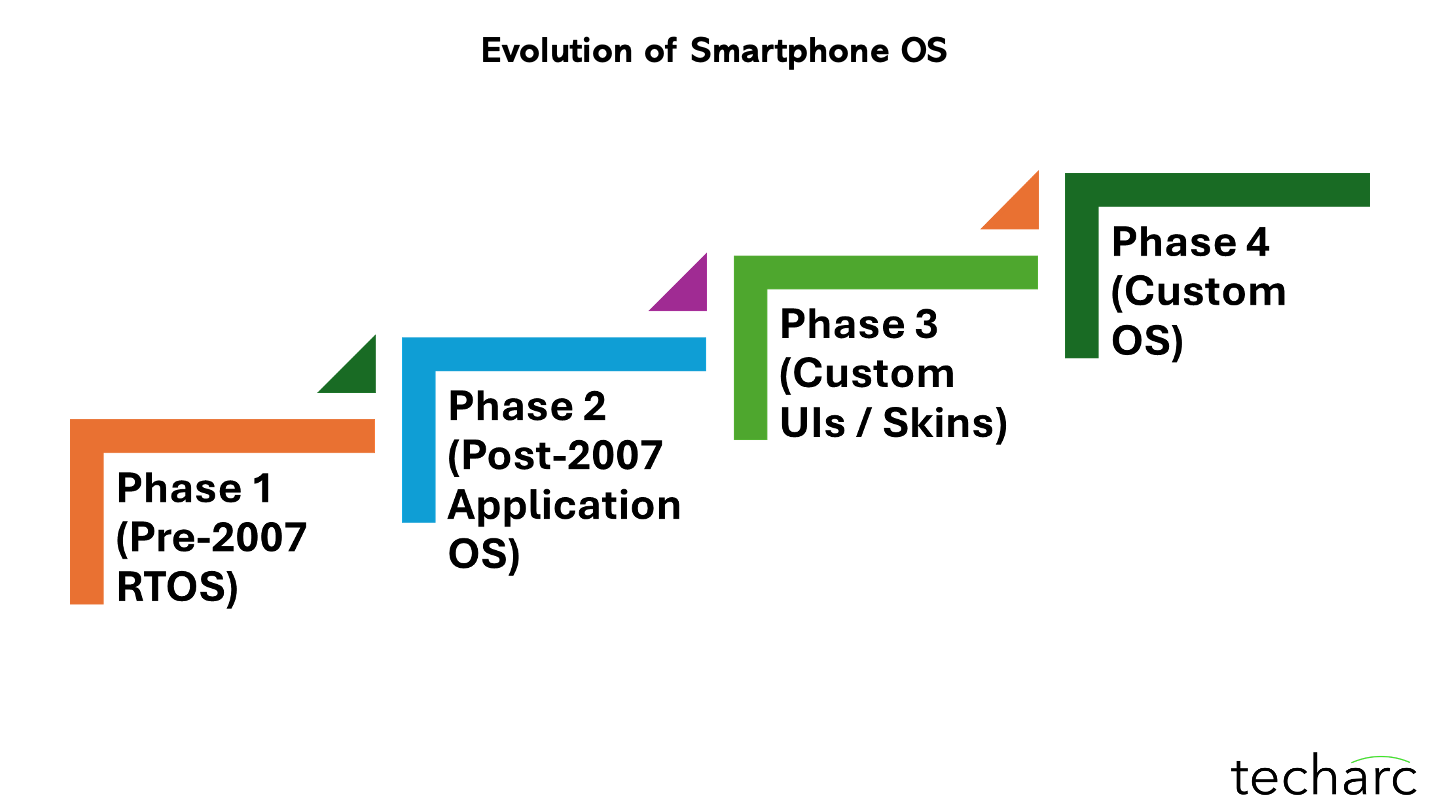
Phase 1 (Pre‑2007 RTOS): Symbian, BlackBerry OS, and Windows Mobile optimized for efficiency and physical input, but fell behind due to poor touch UX and weak centralised app distribution, leading to rapid obsolescence once multi‑touch and app stores set the standard.
Phase 2 (Post‑2007 Application OS) – Duopoly: iOS won on tight hardware‑software integration, seamless ecosystem play, fluid UX, and security; android won via openness and OEM breadth, creating a powerful network effect around app stores that competitors could not match.
Phase 3 (Custom UIs / Skins): New or revived platforms struggled without app parity (e.g., Windows Phone’s “App Gap”), while Android skins (MiUI, Funtouch, etc.) added a differentiated view along with serving business objectives of monetisation through value added services including serving advertisements and preinstalled apps. Some of them also attempted selling content in the form of themes, wallpapers, etc., to enable personalisation.
Phase 4 (Custom OS): Though not absolutely a new idea, custom OS has been there for some time and got all the popularity with OxygenOS after OnePlus shelved CyanogenOS. In the past couple of years, it has become one of the critical focus areas for all leading OEMs and some has started upgrading from UI to this level. We have Samsung’s OneUI, Oppo’s ColorOS, Xiaomi’s HyperOS, Vivo’s OriginOS, to name a few. In China, Huawei’s HarmonyOS is also gaining momentum. Through this custom OS, brands are defining environments in which they enable users to interact with the smartphone and control the experiences they want to deliver. This is not only helping them to create differentiation but also establish their identity.
P-E-P Framework for Smartphone OS Benchmarking
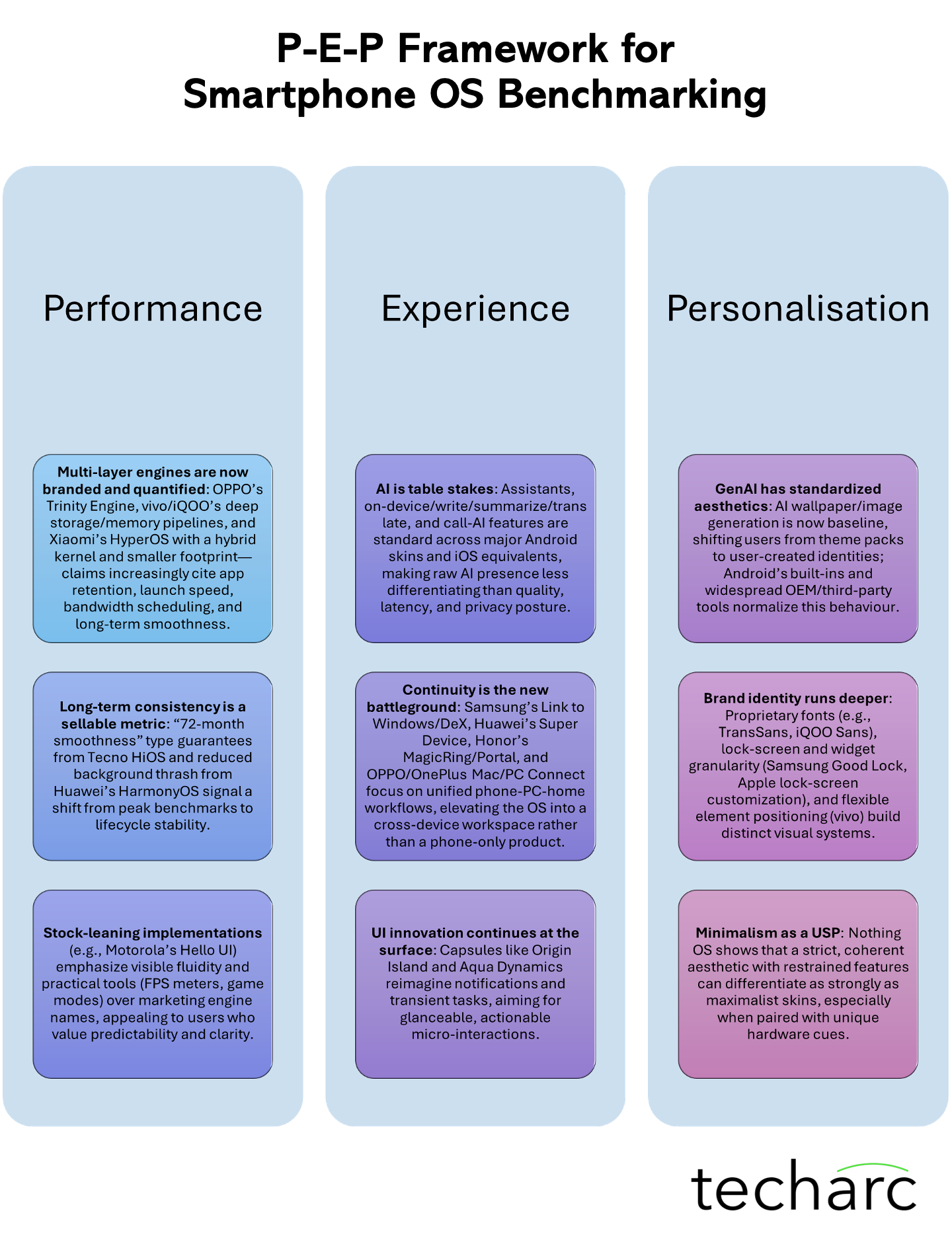
We analysed and categorised the operating systems using the Performance, Experience, and Personalization (P-E-P) framework. Below are the key takeaways.
P-E-P Score
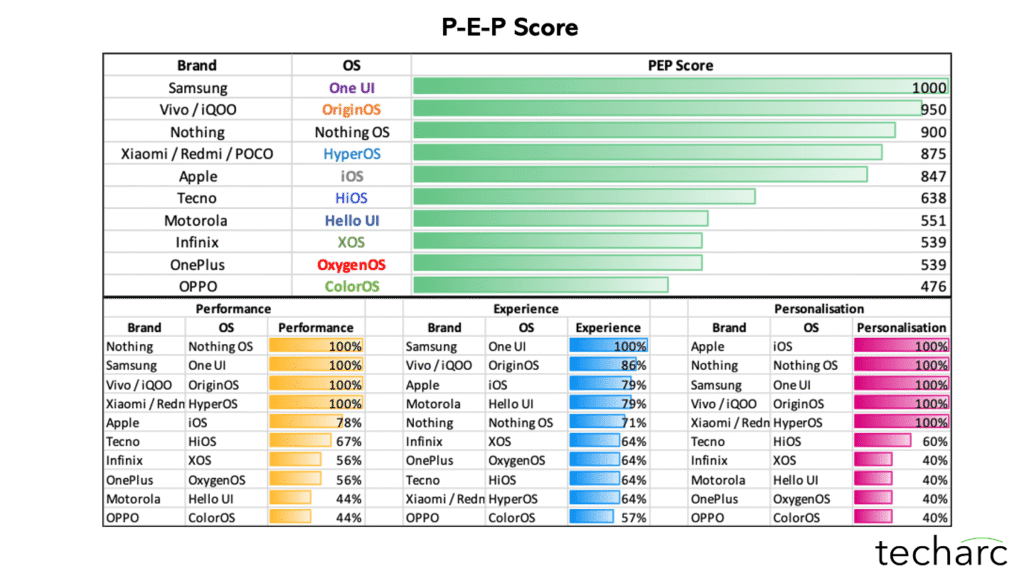
Samsung’s OneUI tops the P‑E‑P (Performance‑Experience‑Personalisation) index with an impressive score of 1000, thanks to its extensive feature set and fine balance across all three pillars. One UI stands out for its fluid performance, rich user experience, and deep personalisation options that cater to both novice and power users.
Vivo’s OriginOS follows closely with a P‑E‑P score of 950, earning particular praise for its distinct design language and user‑experience features that blend aesthetics with utility.
In terms of pure performance, Nothing OS, One UI, OriginOS, and Xiaomi’s HyperOS all achieve a perfect score (100%), reflecting their highly optimised systems and consistent speed metrics. For overall experience, OneUI once again leads the chart, followed by OriginOS and Apple’s iOS, which continues to deliver a refined and cohesive ecosystem.
On the personalisation front, iOS, NothingOS, OneUI, OriginOS, and HyperOS all score a full 100 percent, offering users a broad range of customisation tools and adaptive settings for a more tailored smartphone experience.
What sets them apart?
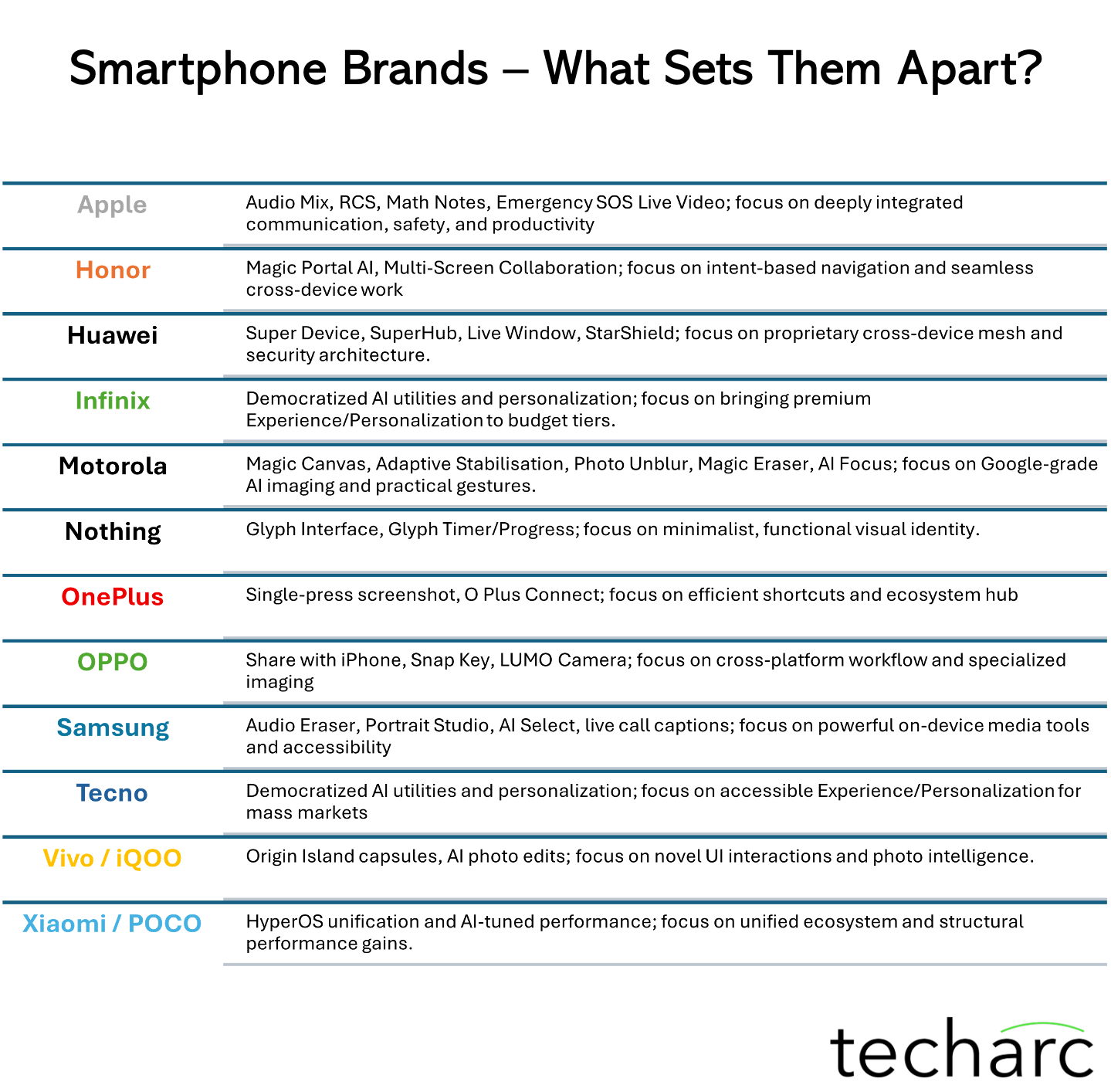
Key Outcomes
- AI‑driven, quantifiable performance is the norm, with OEMs publishing concrete claims around speed, retention, bandwidth, and long‑term smoothness, while AI utilities for writing/summarizing/translation/calls are baseline across major skins.
- Ecosystem continuity has replaced the “app gap” as the strategic frontier, with phone‑PC‑home workflows and desktop‑class modes shaping user choice more than isolated mobile features.
- Generative AI has democratized personalization, moving customization from pre‑made themes to user‑generated visuals via built‑in flows and ubiquitous tools.
- Android skins converge on core capabilities yet diverge through niche USPs—gestures, minimalist or monochrome design languages, notification capsules, and brand fonts—crafting sharper identities over a shared baseline.
- The iOS/Android foundation remains entrenched, letting Android skins compete on rapid P‑E‑P feature iteration without app‑store burdens, while iOS’s tight integration sustains a premium feel, together accelerating global mobile OS innovation.