


Techarc today released its proprietary quantitative scoring analysis for measuring the incremental benefits offered by smartphone models over their predecessors in a series. The analysis was performed on randomly selected models of leading smartphone brands that were launched in the first quarter (Q1) of 2026.
The improvements/upgrades were measured for 4 important attributes of performance: camera, battery, and display. These collectively influence over 80% of the decision-making of consumers for upgrades.
The Upgrade Decision Matrix
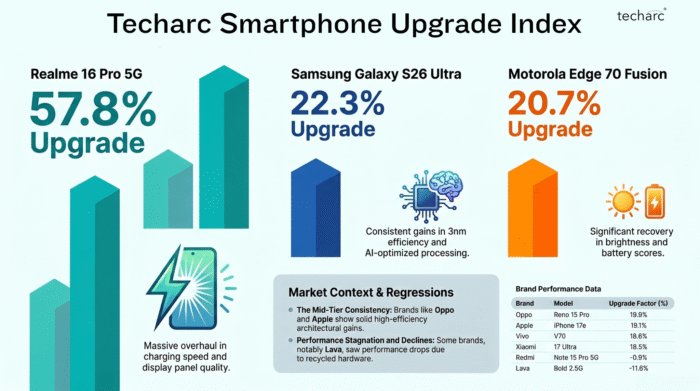
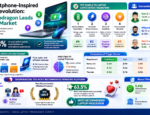
- Realme 16 Pro 5G (57.8%): The largest leap in the report. This total overhaul elevates the series from mid-range to near-flagship status, driven by 100W+ charging and a category-redefining peak brightness display.
- Samsung Galaxy S26 Ultra (22.3%): The leader in the luxe segment. It succeeds through Pillar Balance, offering simultaneous major gains in 3nm efficiency, display tech, and AI hardware rather than focusing on a single spec.
- Motorola Edge 70 Fusion (20.7%): A strategic recovery upgrade. Following a weak 2025 predecessor, Motorola aggressively improved its core weaknesses, screen brightness, and battery endurance to create a top-tier recommendation for 2026.
2. Which is the best segment
2.1 Premium Segment (₹ 30,000-50,000): The Realme 16 Pro 5G is the standout best device across all segments. With a 57.8% upgrade factor, it effectively bridges the gap between Premium and Luxe tiers, making it the most mathematically sound purchase for users seeking the greatest improvement in their daily experience.
2.2 Luxe Segment (Above ₹ 1 Lakh): While the Xiaomi 17 Ultra is a strong competitor, the Samsung Galaxy S26 Ultra wins the Luxe segment. Its 22.3% growth is driven by a focus on Pillar Balance, meaning it improved significantly in Performance, Display, and Power simultaneously, whereas others often prioritize only one area.
2.3 Premium Pro Segment (₹ 50,000-1,00,000): The competition between Oppo (19.9%) and Apple (19.2%) is the tightest in our analysis. Oppo takes the best title here because its upgrade factors (specifically in Charging Watts and Main Camera sensor size) provide a more noticeable real-world utility jump than Apple’s primarily processor-focused iteration.
2.4 The Base segment (₹20,000-30,000): In the Base and Mid segments, the best devices (IQOO and Redmi) are currently showing stagnant or negative upgrade factors. This suggests that in the 2026 cycle, consumers in these segments are better off holding onto their current 2024/2025 devices, as the latest versions do not yet offer a compelling reason to spend.
Key Technology Drivers and Trends
3.1 The Diminishing Returns of Processing Power
Analysis shows that while Process Design has reached the 3nm frontier (seen in the iPhone 17e and S26 Ultra), the felt speed for the user has plateaued. Manufacturers are now shifting their Performance focus toward Proprietary AI integration and UFS 3.1/4.0 Storage speeds to eliminate system latency.
3.2 The Display Brightness Revolution
One of the most significant reasons to upgrade in the 2026 cycle is display quality. We have observed a move from 1,200 nits as a baseline to 6500 nits in the latest versions of mid-to-high luxe devices. This provides a transformative difference in outdoor usability that older devices cannot match.
3.3 The Power Divergence
There is a widening gap in the Battery Score. Brands like OnePlus and Motorola have pushed charging speeds to the 50W–100W range, while legacy giants like Apple and Google remain under 30W. This creates a scenario where a mid-range latest version may outscore a flagship in the Power Resilience pillar.
Strategic Conclusion
For a professional procurement or personal purchase strategy, the data suggests the following:
Monitor the Delta: Only consider the latest version if the Upgrade Factor exceeds 15%. This ensures that the capital expenditure results in a noticeable change in productivity and utility.
Focus on the Pillar Jump: Identify which specific pillar drove the score. If a device has a high score solely due to a higher-megapixel camera but you prioritise battery, the latest version is not the correct choice for your specific needs.
The Luxury Consistency: High-end models like the Samsung Galaxy S26 Ultra maintain a consistent 22.3% higher score over its predecessor. This suggests that the Ultra series is one of the few lines where a yearly or bi-yearly upgrade remains mathematically justifiable due to consistent technological jumps.
Footnotes
- Relative Normalization: All scores (0–10) are relative to the minimum and maximum values present in the specific 2024–2026 dataset. A 10 represents the best-in-class hardware currently available in this specific cohort, not an absolute theoretical limit.
- Process Inversion: The Process Design (nm) score is mathematically inverted. For example, a 3nm chipset scores significantly higher than a 4nm or 6nm chipset to reflect higher technological maturity.
- Hardware vs. Experience Gap: Scores reflect raw hardware capabilities. Software optimisations (AI-based post-processing, OS-level battery management) and user interface (UI) smoothness are not captured in the numerical scoring but may impact real-world usage.
- Missing Data Handling: In instances where specific specifications (e.g., Pixel Density or Charging Wattage) were not provided, the metric is filled using the dataset mean or a conservative baseline to prevent score distortion.
- Pricing Volatility: The analysis uses the operating price in INR at the time of the launch of the device. Market fluctuations, taxes, and post-launch discounts are excluded from the Upgrade Factor calculation, which focuses solely on technological gain.
About the Analysis
The analysis is derived through a proprietary framework developed by Techarc that measures the quantifiable upgrade attributes of a smartphone compared to its predecessor in the series. In the present report, a smartphone launched in Q1 2026 was compared and measured with its L-2 (Latest minus 2) model, which were launched in 2024. There were a few exceptions to this rule like iPhone E and Tecno Pova Curve series, which did not have a model in 2024. The smartphones were compared on measurable attributes regarding performance, camera, battery and display – 4 factors having more than 80% impact on the decision to upgrade for smartphone users.
The purpose of this analysis is to ascertain which brands have significantly improved their latest models of a series and have a higher incremental value to offer to users. The analysis also factors the price change consumers pay over the previous model.