



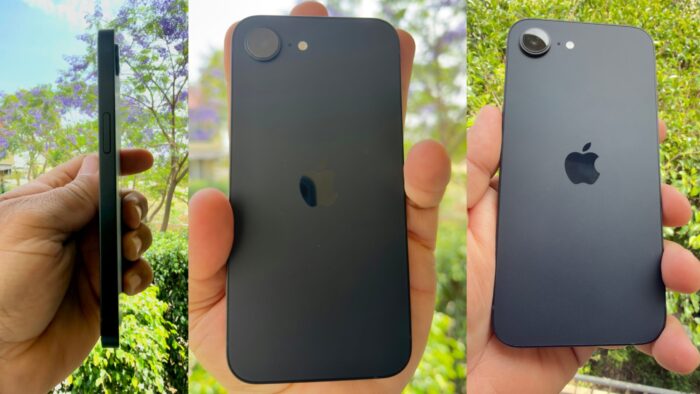
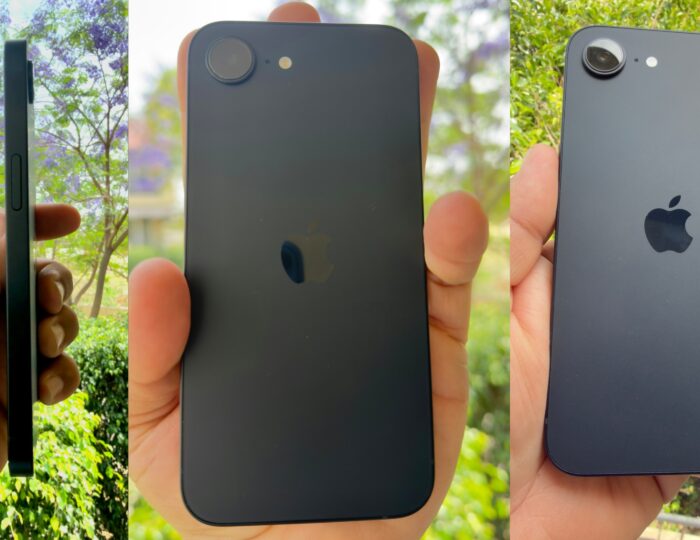
The iPhone 17e represents a fundamental shift in Apple’s hardware strategy. Moving away from the budget-compromise model of previous years, the 17e reframes the entry-level value proposition by integrating flagship-grade silicon (A19) to create a streamlined, AI-ready power tool rather than a diluted flagship.
- Lowering the Entry Barrier: Strategic Market Dilution
Apple has successfully begun lowering the entry barrier to its ecosystem, a threshold that remained high for years. Consumers can now enter the Apple ecosystem at the $700 price point. While some may perceive a 10% price increase over the predecessor, a deeper analysis reveals a more nuanced reality: while the USD-to-INR exchange rate fluctuated by 5% annually, the effective price increase remained marginal at 4%.
More importantly, Apple is shifting the value proposition by upgrading core hardware, such as the transition from a A18 to A19, 4.26 Ghz clock speed. This proves that lowering entry barriers is not solely about price reduction, but about optimizing specs and hardware to drive perceived value. Following the success of this E-series strategy, Apple is well-positioned to replicate this model across other product lineups, enabling a broader user base to enter the ecosystem at a more accessible price point.
- Bridging the Performance Gap
The inclusion of the A19 chip is the 17e’s most aggressive move. While it features one fewer GPU core than the Pro models, the real-world delta is negligible for 95% of users. This chip isn’t just about speed; it is the gateway for Apple Intelligence, enabling the 17e to handle on-device AI tasks like object identification and advanced image editing as fluidly.
- Techarc Unboxing Score
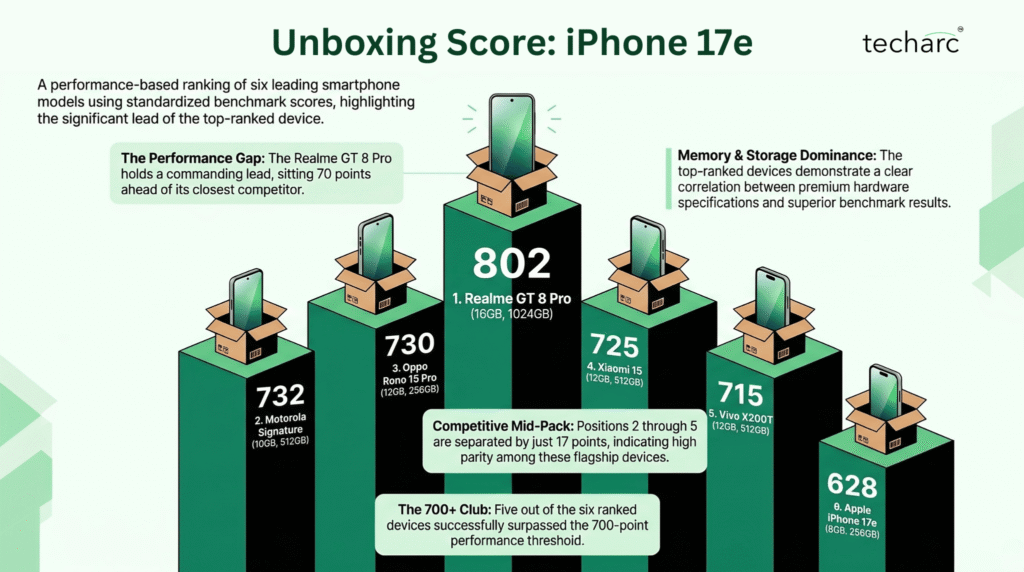
Despite its strategic strengths, the iPhone 17e could not perform well in our proprietary Unboxing Score, due to the aggressive hardware omissions, earning just 628 points and landing in last place among its five competitors. Within the ₹64,000–₹75,000 range, the realme GT 8 Pro leads with an impressive score of 802, followed by the Motorola Signature (732), the OPPO Reno 15 Pro (730), the Xiaomi 15 (725), and the vivo (715). This last-place finish is due to several factors, including its single-camera system, a lower-tier chipset, and a smaller battery.
- Durability as a Feature
Apple is solving a long-term hidden cost for budget users: screen damage. The Ceramic Shield 2 offers three times the scratch resistance of previous generations. Paired with the new anti-reflective coating, it reduces the need for third-party screen protectors, which ironically often degrade the display’s visual quality.
- The Targeted Trade-off
By retaining the 60Hz refresh rate and the traditional notch instead of the Dynamic Island, Apple keeps the price at ₹64,900 while doubling the base storage to 256GB. For the everyday user, those upgrading from an iPhone 12 or XR, these omissions are invisible compared to the massive gains in chip and battery longevity.
- Recommendation
The iPhone 17e is the most justifiable entry-level iPhone to date, successfully transitioning the base tier from a compromise to a calculated choice.
- Upgrade Immediately If: You are currently using an iPhone 13 or older. The leap in storage, durability, and AI capability is transformative.
- Maintain Current Device If: You are a current ProMotion (120Hz) user. The regression to 60Hz will be jarring, regardless of the A19’s processing power.
- Top Specifications
| Feature | Specification |
| Processor | Apple A19 (3nm Fabrication, Hexa-core) |
| Display | 6.1-inch Super Retina XDR OLED (60Hz) |
| Durability | Ceramic Shield 2 (3x Scratch Resistance) |
| Camera | 48MP Fusion (Rear) / 12MP Ultra-Wide (Front) |
| Charging | USB-C, MagSafe (15W), Qi2 Support |
| Battery | 4,005 mAh (Up to 26 hours video playback) |
| Variants | 8/256 & 8/512 |