


The technology landscape in March 2026 has been defined by a sharp V-shaped recovery in launch momentum, particularly with smartphones. After a stagnant start to the year, the industry appears to be shaking off its first-quarter slumber, though the data reveals a growing structural divide between premium aspiration and entry-level accessibility.

1. Smartphone Market: A Resurgent Spring
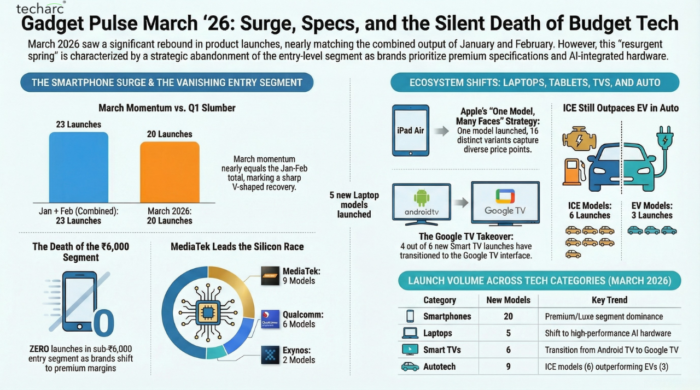
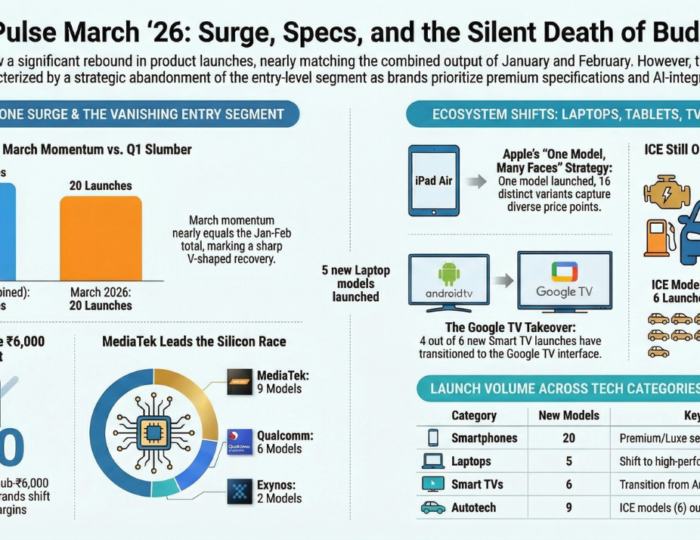
The smartphone industry witnessed a significant rebound this month, nearly doubling the activity seen in February. While the first two months of the year saw a combined total of only 23 model launches, March alone delivered 20 new models. This surge suggests brands wanted to coordinate launches with spring release cycle.
- Volume and Variety: A total of 45 variants were introduced across 11 distinct brands. Samsung led the charge with 4 strategic launches, while Realme followed closely with 3, Nothing, Xiaomi, Oppo & Poco have 2 each. Rest brands share 1 launch each
- The Vanishing Entry Segment: A critical observation is the complete absence of any model in the sub-₹6,000 Entry Segment. While the Premium (7 launches), Luxe (6), and Mid (6) segments are thriving, the industry seems to have collectively shifted away from the ultra-budget buyer. This suggests a strategic shift toward protecting margins through higher Average Selling Prices (ASP).
- Silicon Leaders: MediaTek continues to hold the pole position in the chipset race, powering 9 of the new models. This indicates strong confidence in the Dimensity lineups across the mid-to-high segments. Qualcomm remains a formidable second with 6 models, Exynos comes third with 2 model launches, while Apple, Google, and Unisoc maintained a niche presence with a single model each.
2. Laptops: The Pursuit of Power over Price
In contrast to the smartphone surge, the laptop market saw a tactical contraction. With only 5 models with 9 variants compared to February’s 7 model launches, the focus has shifted almost exclusively to high-performance computing.
- Brand Concentration: The market is led by Apple with 4 launches, supported by a single entry from Asus. The absence of other major OEMs this month highlights a quieter period for traditional productivity hardware.
- The Spec War: Similar to the smartphone trend, the Entry Segment for laptops has effectively vanished. Manufacturers are prioritizing Luxe and Premium specifications, likely to cater to the growing demand for AI-integrated hardware—leaving budget-friendly buyers with fewer options as brands prioritize technical prowess over affordability.
3. Tablets: The Hyper-Segmentation Strategy
The tablet market remains steady in terms of model volume, but the underlying data reveals a massive push in SKU (Stock Keeping Unit) diversity.
- The iPad Air Phenomenon: While only two new tablet models were launched (one from Apple and one from Xiaomi), the total variant count skyrocketed to 18. This is primarily driven by Apple’s decision to launch the iPad Air in 16 different configurations of size, storage, and connectivity.
- Analytical Insight: This one model, many faces strategy allows Apple to capture a broader range of price points within the Luxe and Premium segments without the overhead of designing multiple chassis.
4. Smart TVs: The Software Paradigm Shift
The television sector is gaining significant pace, with 6 models and 7 variants hitting the market. The most compelling insight, however, lies in the underlying software.
- The Google TV Takeover: Out of the 6 new launches, 4 are powered by Google TV, while only 2 remain on the legacy Android TV platform. This confirms a clear industry-wide transition toward the more refined, content-centric Google TV interface.
- Market Balance: Unlike personal electronics, the Smart TV segment maintains a healthier distribution across price brackets, with 3 mid-segment launches and 2 entry-level models, ensuring that the home entertainment market remains accessible.
5. Autotech: The Electric Inevitability
The automotive sector showed a slight increase in volume compared to previous months, but the underlying data reveal a market that is still firmly anchored in traditional powertrains despite the electric push.
- Balanced Portfolio Mix: Out of the 9 total passenger vehicles launched this month, ICE (Internal Combustion Engine) models significantly outpaced EVs. With Petrol (5) and Diesel (1) accounting for 6 out of 9 debuts, it is clear that 2026 to remain a year of co-existence rather than a total EV takeover.
- Strategic ICE Focus: Brands like Lexus, Mahindra, and Tata are signalling that while they are future-proofing with 3 new EVs, their primary volume and performance drivers for March remain tied to petrol and diesel. This ICE-first volume strategy indicates that the immediate market demand is still being met by refined traditional engines.
Footnotes
- Reporting Period: March 1 – March 26, 2026.
- Data Source: Techarc India New Launch Tracker (Smartphones, Laptops, Tablets, Smart TVs, and Autotech) – (Compiled through real-time monitoring of OEM press releases, regulatory filings, and verified retail listings)
- Geographical Distribution: This report focuses primarily on the Indian market landscape.
- Data Accuracy Disclaimer: There is a chance of 5–7% variation in the collection due to delayed reporting from regional distributors and rolling launch windows across different retail channels.
Share: