




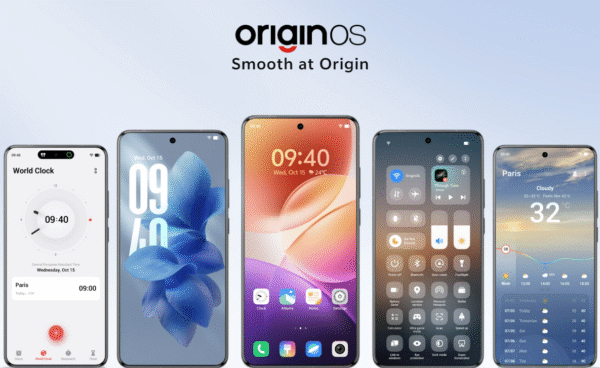
Vivo just announced arrival of OriginOS, which will first power some of the select flagship smartphones of Vivo and iQOO and later on become the default interface of their smartphones.
The core smartphone OS – Android – has not been able to give the smartphone OEMs all they need to deliver superlative experiences to their customers. Especially, as they move up the ladder to serve premium smartphone users, where it faces off with Apple’s iOS which has set the benchmark of smooth, simple and secure interface resulting in a hassle-free, no-nonsense experience to the smartphone users.
To overcome this gap between what Android can deliver and what customers want to experience, all the major OEMs using Android as the OS have built a layer of their own on top of it to elevate the user experience and create a level of differentiation within the Android ecosystem. Of course, there are business interests as well, such as monetization through serving ads or promoting apps to their respective user bases. However, of recently, the focus on monetization has reduced and creating delightful experiences has taken precedence over everything. It makes all the sense as the monetisation avenues available do not significantly add to the revenues these OEMs make from their user bases. But if they can create happy and satisfied customers, they will repeat them and also buy other gadgets, making a smart ecosystem.
Smartphone OEMs using Android as the core OS have developed their additional layer to deliver the experiences they want to be recognised for. Samsung has OneUI, Xiaomi has its HyperOS, Oppo has ColorOS, OnePlus uses OxygenOS and now Vivo has OriginOS. All of them want to control the final experience they want to be known for and differentiate through. Also, some of them, like Samsung and Xiaomi, have an ecosystem of devices, and they use the OS as an integrating layer resulting in seamless connectivity and experiences.
While these OEMs see OS as an opportunity to differentiate and control the experiences they want to deliver, it is now also becoming essential as they foray into premium tiers of customer segments. The premium tier customer benchmarks the smartphone experience with iPhone, which they might already be owning. Many users in the tier use an additional Android smartphone while continuing using iPhone as their primary smartphone. They want their Android smartphone to have similar comparable experiences. The premium tier user also wants clutter-free UI, greater control on what and how they want the screen to be, more customisation options to personalise the device, protect and safeguard data and privacy and flexibility to be either a minimalist or a maximalist. It is all these features that the OEMs enable through their own OS layer, elevating the overall smartphone experience.
Paigham Danish, Head of Vivo’s Product and GTM in India, notes in this blog that the essence of OriginOS is well captured, addressing gaps between user expectations and Android’s limitations.
It’s for time and consumers to decide and give their verdict about OriginOS. Will it be seen as another OS for smartphones, or will users find it additionally elevating the experiences, giving Vivo an edge in the market, especially in the premium tiers? Considering how Vivo has performed so far and added value to all the elements, including hardware, it looks like OriginOS is set to deliver a different and sustainable experience to users.
This leaves Pixel by Google in a difficult position in the market which doesn’t have any additional layer as compared to other brands in the market. The users in different segments, including premium, will benefit from operating systems of these OEMs to get additional features, greater control, better personalisation and more security, satiating their essential requirements.
As we wrap up 2025, the smartphone industry is ushering into an interesting era, where the value will be driven by experiences which is a sum of hardware and software. OEMs, including Vivo, which have invested equally in both the faculties will reap fruits.
Others who have only focused on hardware or software may not be able to delight millions of customers. This is the time for the smartphone industry to start looking holistically at customers and do away with the ‘split vision’ syndrome of compartmentalising individual elements of a solution, resulting in uneven experiences.